For women who have been told to be careful
89% vs. 16%: a 1984 study split 59 women with spinal osteoporosis into two exercise groups. One direction nearly stopped new fractures.
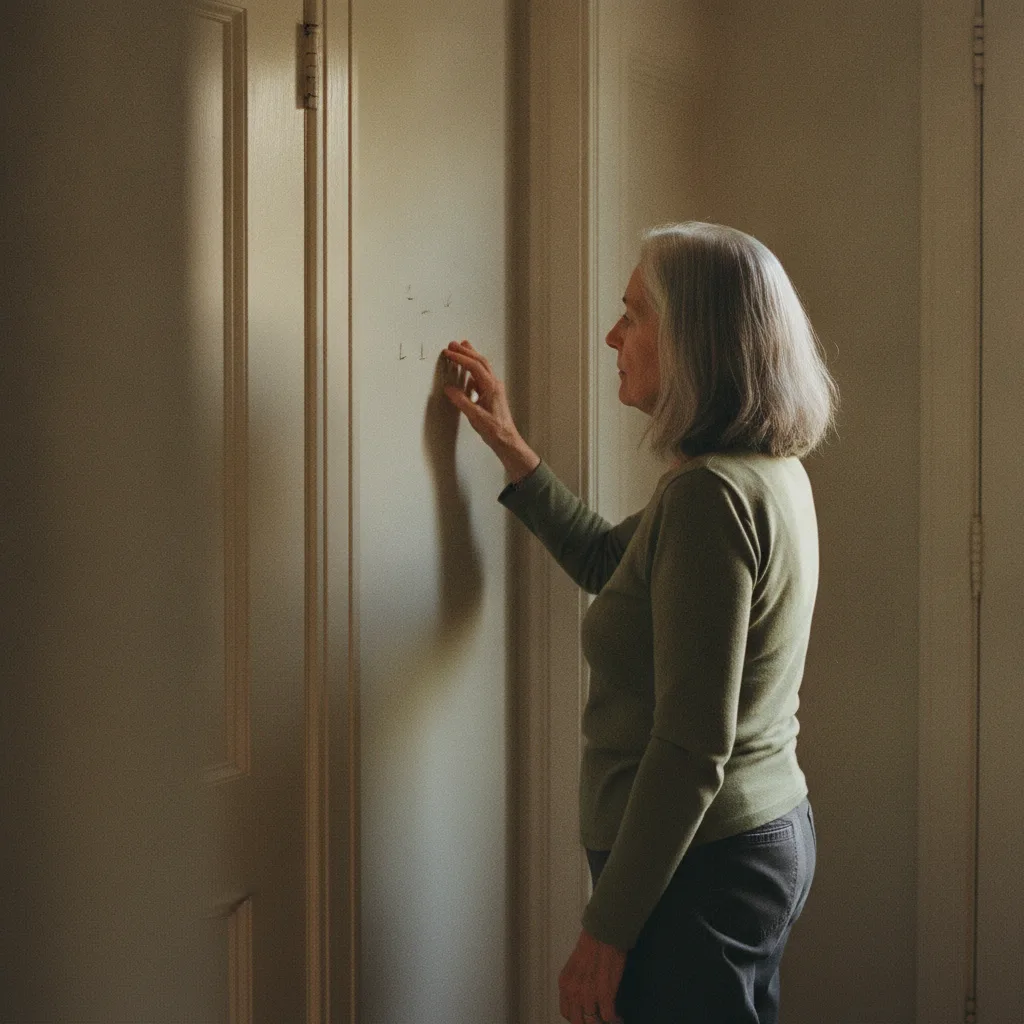
"Being careful" quietly trains a fragile spine toward the exact bending direction that broke it in the first place, one weak month at a time. Twelve weeks the other direction, nothing but a chair and a folded blanket, and four numbers tracked in your own kitchen say whether it worked.
Nobody told you which group you have been in for the last year. That is what this page is for.
If a bone in your spine has already broken, somebody has said those two words to you a hundred times. Your doctor said them. Your daughter says them. The voice in your own head says them at the top of every staircase.
So you did what anybody sensible would do. You handed over the heavy pans. You gave up the class. You learned to move like something breakable.
And nobody in that whole chain of well-meaning people knows the second half of the sentence.
Every month you spend moving like glass, the muscles that hold your spine upright get weaker. The weaker they get, the further forward you tip. And the further forward you tip, the more of your weight presses on the one edge of each bone that fails.
The advice was not wrong. It was half. And the missing half is the difference between a spine that gets through the next ten years and a spine that does not.
On this page, in about ten minutes:
- The four-step spiral that quietly turns "being careful" into the next break, and the one place it can be interrupted. It is not where you think.
- A finding published in 1984 about which direction of movement breaks spines like yours. Forty years later it still has not reached the exercise videos aimed at your age group, and some of them are teaching the exact movement it warned about.
- The two-inch movement that does more to keep you upright than anything a machine in a gym can do, and the mistake almost everybody makes in the first week of doing it.
- What actually decides whether a fall at seventy-four is a bruise or an ambulance. It is not the fall.
I am a physical therapist, 22 years of it, and the women who sit across from me tell me things they have not told their families. I know about measuring yourself against the door frame. It comes up more than you would believe.
If you have broken a bone in your spine, or your DEXA score is -3.0 or below, or you have stenosis, this page was written about you specifically. And if the scan only ever said osteopenia and a bone in your back went anyway, you are not an odd case and you are not in the wrong place. Read all of it. The women who most need what is on it are the ones most likely to close it, because they have been told to be careful about everything, including hope.
This is for you if
- You have broken a bone in your spine, at any point in your life
- Your T-score is -3.0 or below
- You have been told you have stenosis or spondylolisthesis
- A doctor has told you not to lift weights
None of those you? Then your spine can probably be loaded, which is the better programme when it is available. That one is here.
Written by Physical therapist, twenty-two years in orthopaedic and bone health rehabilitation.
What the last year has actually been like
Let me say some of it out loud, because in my experience nobody else has.
You are frightened of coughing. Not in a way you would tell anybody, but there was a chest infection last winter and every cough had a little jolt of dread on the end of it.
You have measured yourself against a door frame. Maybe more than once.
You do not bend at the waist any more, ever, for anything. You have worked out a whole set of ways round it. You lower yourself down on one knee to get something out of a low cupboard. You use the grabber. You ask somebody else to get the pan out.
You have stopped going to some things. Not dramatically, and you have a reason ready for each one. The pavements are uneven there. It was a long drive. You did not fancy it.
And you have said none of this to anybody, because the alternative is being treated as fragile by people who love you, and being treated as fragile is its own kind of loss.
If some of that landed, then you and I are having the same conversation I have had a few hundred times in a clinic room, and I know what comes next in it. It is usually a version of: so what am I supposed to do, just wait?
No.
Four things this page answers before it asks you for anything:
- Why careful, followed faithfully for a year, walks toward the thing it is avoiding
- What actually protects a spine that has already broken, and what has nothing to do with it
- The four numbers you take in your own kitchen, and what they measure
- Why the floor stopped being somewhere you go, and how it comes back

Why careful stops working
Here is what happens to a spine when the only instruction is to protect it.
Your back has muscles running up either side of it whose entire job is holding you upright against gravity. They work all day, every day, without being asked. And like every muscle, they get weaker when nothing demands anything of them.
Being careful means asking for less. Less bending, less lifting, less reaching, less carrying. So those muscles get quieter and weaker, month by month, and nobody notices because there is no moment where it happens.
Then this: a weaker back means you spend more of your day tipped slightly forward. Not bent over. Just a degree or two more than you used to be, at the sink, in the car, watching television.
And forward is exactly where it matters.
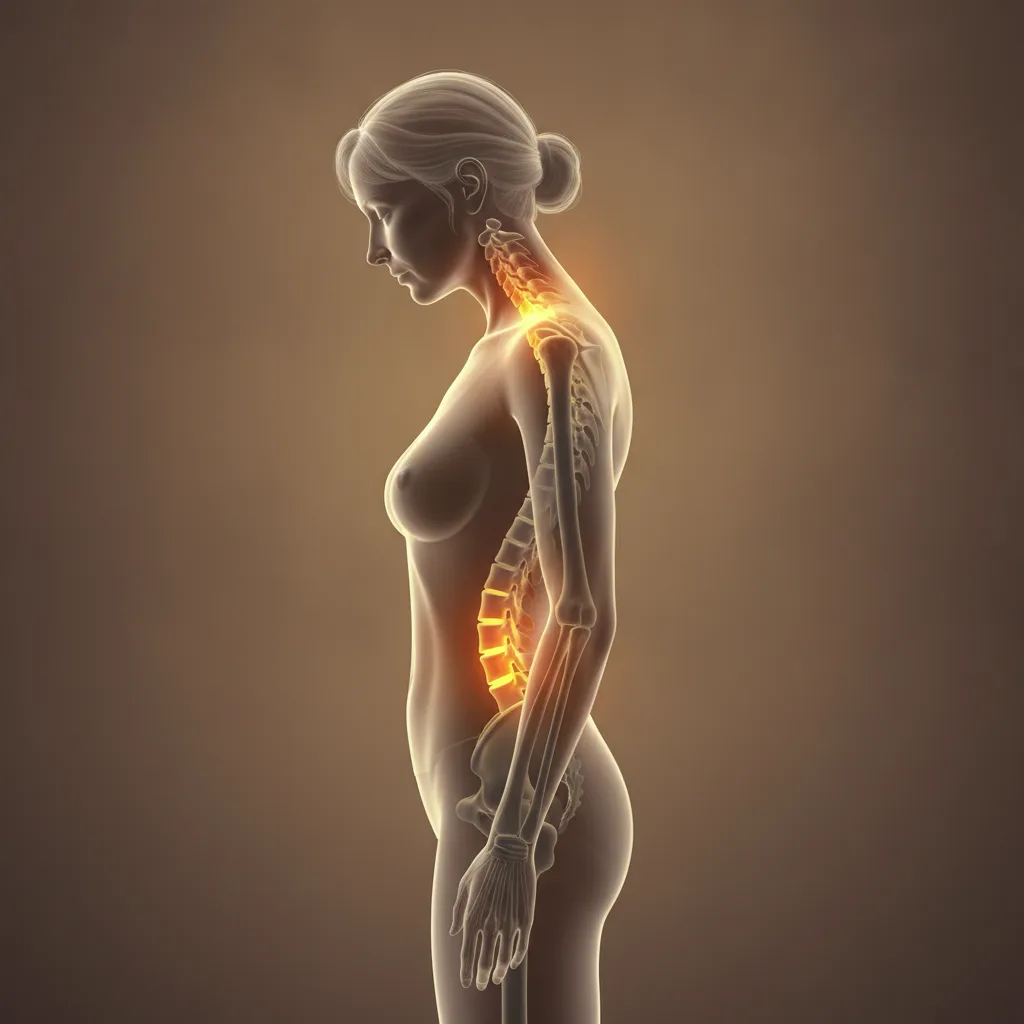
When you lean forward, the load through your spine moves onto the front edge of each bone. That front edge is the part that gives way first in a thinning spine, and it is why the bones that break tend to squash into a wedge shape rather than snap.
So look at the loop.
Be careful, so use your back less. Use it less, so it gets weaker. Weaker, so you spend more of the day tipped forward. Tipped forward, so the load sits on the exact edge that fails.
Round again, a bit further, every year.
That is the spiral, and everyone with a spine like yours is somewhere on it. The advice that put you there was given with good intentions by people who were right about the first half and never said the second half.
The mechanism
A back that is used less gets weaker, a weaker back spends more of the day tipped forward, and forward is where the load lands on the front edge of each bone in the spine. That edge is the part that gives way.
Sinaki and Mikkelsen, 1984. Later follow-up work by Sinaki on back extensor strength.
The answer is not to protect your spine. It is to get strong enough to hold it up.
The part of this that has been known since 1984
I know how that sounds. Your doctor did not get this wrong out of carelessness, and you did not get it wrong by listening to her. Be careful is what almost everybody says, it sounds like the safest sentence in the world, and I said it to patients for years before I stopped.
What changed my mind was not an argument. It was the paper below, and the fact that I could not find a way around it.
This is not new and I did not invent it. It was published in 1984, and it has been sitting there ever since.
In 1984, Sinaki and Mikkelsen split fifty-nine women with spinal osteoporosis by the kind of exercise they were given. One group bent backward. One group bent forward. When they looked at who had broken a new bone in the spine: sixteen percent of the backward-bending group had. Eighty-nine percent of the forward-bending group had. (Sinaki M, Mikkelsen BA. Postmenopausal spinal osteoporosis: flexion versus extension exercises. Arch Phys Med Rehabil 1984;65:593-596.)
Read those two numbers again, because they are the reason this page exists.
That is a forty year old finding, and it is still not in most of the exercise videos aimed at women your age, which is why you will still find sit-ups in them and standing toe touches in them and an instructor in her thirties telling a room of women in their seventies to reach for their shoes.
Later work by the same researcher followed women who had strengthened their back extensor muscles, and found fewer broken bones in the spine years afterwards than in women who had not.
And separately from bone entirely: balance and leg strength training reduces falls in older adults, which is one of the better established findings in this whole field. Which matters here more than anywhere else it could matter, because a hip almost never breaks on its own, sitting there in a body going about its day. It breaks in a fall.
Which answers the question at the top of this page, the one about whether a fall at seventy-four is a bruise or an ambulance. It is almost never the fall that decides. It is what your legs can do on the way down and what you can do about it once you are on the floor. Both of those are trainable, at any age, and neither of them is.
Three things, then. Strengthen the muscles that hold you upright. Never bend forward under load. And do not fall over.
That is the whole programme, and if it sounds simple, it is. What it is not is easy, and what almost nobody has is somebody to write it down session by session and tell them what to do on a Tuesday.
What The Upright Protocol actually is
Twelve weeks. Twenty-four sessions, two a week, twenty to forty minutes each.
There is no barbell in it. Not in week one, not in week fifty-two. Nothing goes on top of your spine at any point, because putting weight on top of a spine like yours is the thing we are avoiding, not the thing we are doing.
There is no equipment to buy. A dining chair, a wall, a folded blanket for the floor, and a bag of shopping. That is the list. Some women add a pair of two-pound ankle weights around week nine, which cost about twelve dollars. I do not sell them.
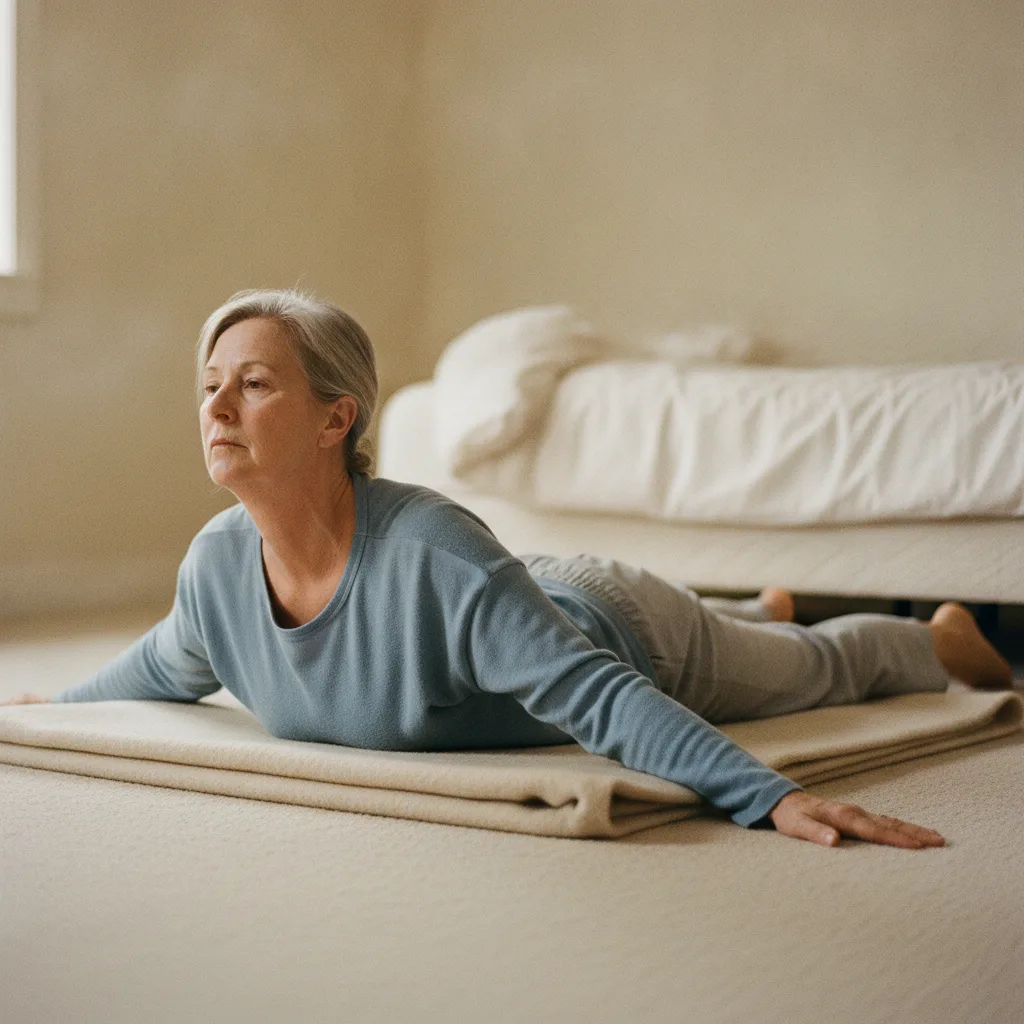
Phase 1, weeks 1 to 4. Upright. Eight sessions learning five movements, all of which will feel too easy. The main one is lying face down and lifting your chest two inches off the floor. That is not a warmup, it is the most important thing in the programme, and by week nine you will be holding it ten seconds at a time with your arms out.
Phase 2, weeks 5 to 10. Steady. Twelve sessions where the holds get longer, the chair gets lower, and the balance work goes to one foot. Session eighteen is the one nobody else teaches: getting up off the floor, practised in a fixed order, on a blanket, next to a chair, until your body knows it.
Phase 3, weeks 11 to 12. Confident. Two hard sessions, one week that is deliberately lighter than you will want it to be, and an assessment that writes down four numbers you will measure next year against.
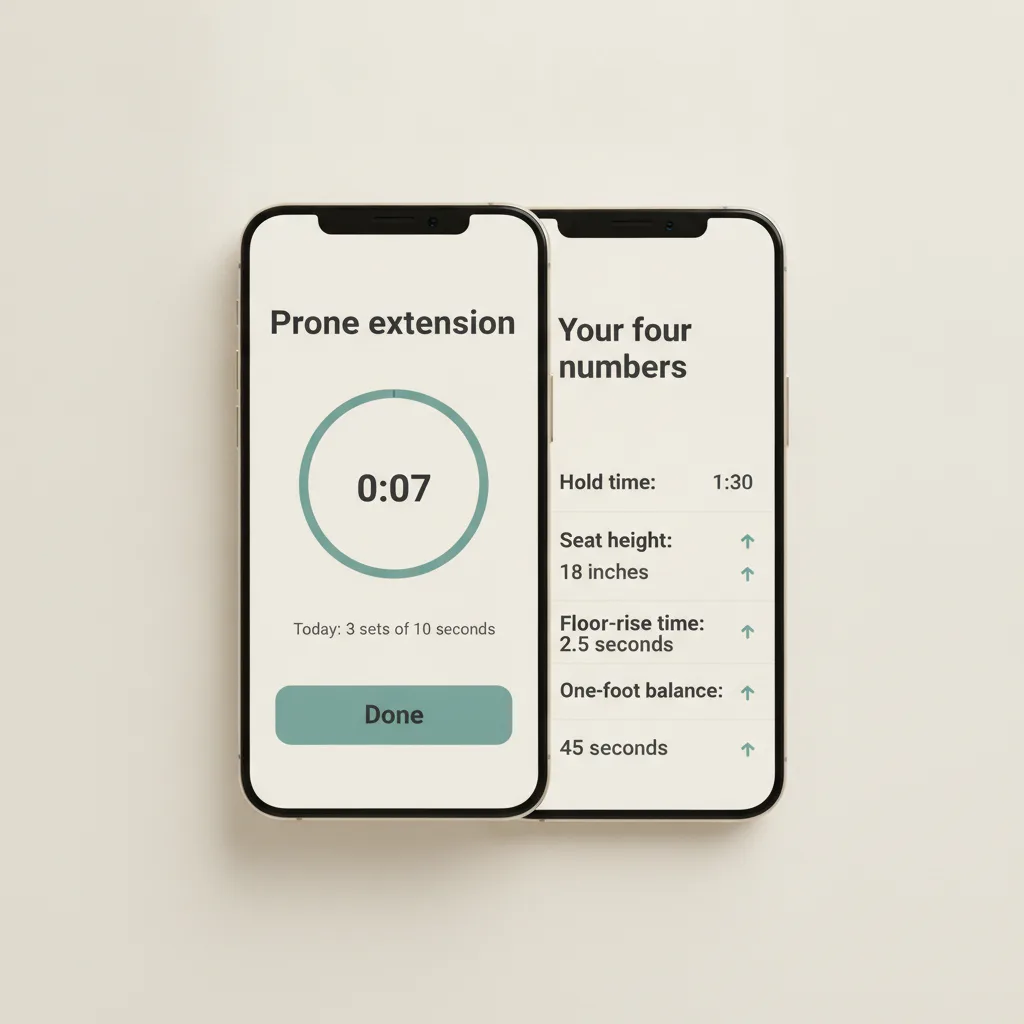
And the app tells you what to do and why. Every session opens with today's numbers already filled in and a plain sentence underneath explaining the reason for them. Logging a set is one tap. At the end of every session it shows you what you did today against what you did in week one, because there is no scan that will show you what four weeks of this did and you deserve to see something.
The programme, at a glance
- What it is
- Twelve weeks of getting the muscles that hold your spine upright strong again. Twenty-four sessions, written one at a time, in an app that tells you what to do and why.
- What it asks of you
- Twenty minutes, twice a week, at home.
- What you need to buy
- Nothing. A dining chair, a wall, a folded blanket and a bag of shopping with tins in it. You already own all four. No barbell, and nothing that goes on top of your spine, at any point in the twelve weeks.
What you get for $16.99
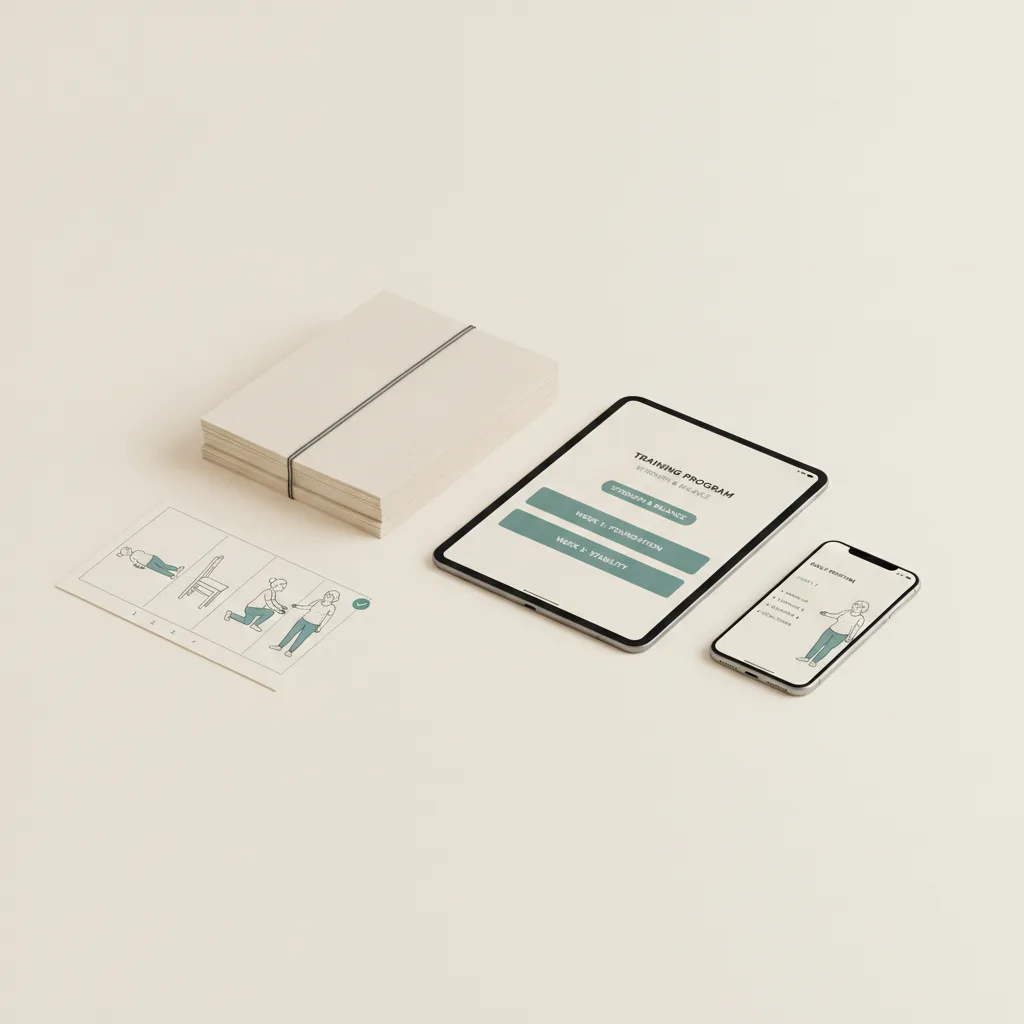
- 24 sessions across 12 weeksTwo a week, 20 to 25 minutes each, at home. Written out one at a time, not a template you fill in yourself.
- Both paths, in full: the floor and the chairThe app asks you once, before your first session. The three lying-down movements run standing, at a wall or a counter, with their own cues and drawings, and you never see the version you did not pick. Switch in Settings any time; nothing you log is lost.
- The getting up off the floor module, week 9Taught as a fixed sequence, next to a chair, in the order your body should learn it. Almost nobody else teaches this.
- The app that runs itEvery session opens with today’s numbers already filled in and one plain sentence saying why they changed. Logging is one tap.
- Your four numbers, measured at the start and the endChest lift hold, one-foot hold, chair stands in 30 seconds, and how far you can reach without moving your feet. Printed, so next year is a comparison rather than a memory.
- Never Do TheseThe three movements that break a spine like yours, with the reason for each one.
- The Doctor BriefingTwo printable pages with the citations on them, written to hand across a desk at your next appointment.
$16.99, once. Nothing renews.
No subscription to cancel. No supplement. No equipment you have to buy from me. At checkout there is one optional add-on, The Everyday Spine, for $14.49. The box starts empty.
From women with a spine like yours
5.0from 3 reviews
These are individual experiences and they are not typical results. Nobody here is promised anything about fractures or scans, and the four numbers move at different speeds for different people.
I broke two vertebrae in the same year and after that my doctor's whole file on me was one word, careful. I did the chair version because getting down on my bedroom floor terrified me before I even started. The floor didn't scare me by week seven. I still keep the Never Do These page stuck to the fridge.
Helen K.69, two compression fractures
My score is bad enough that the app for the other programme wouldn't even let me past the first question, which is exactly what it's supposed to do. This one met me where I actually was. The chest lift felt like nothing for the first two weeks and I nearly gave up on that basis alone. Glad I didn't.
Diane R.74, T-score -3.4
I brought the doctor briefing to my neurosurgeon, not my GP, because of the stenosis, and he read both pages standing in the hallway and said carry on. That two minutes did more for my confidence than the whole first month of sessions.
Nancy P.71, spinal stenosis
What Tuesday actually looks like
Twenty to seven, bedroom floor, kettle on. This is a real session from week five, so you can see how small this is from the inside.
You open the app. It says what today is, and there is one button.
Five minutes of warming up that needs no equipment and no space: walking the hallway, rolling your shoulders back, tucking your chin. Then the extension: face down on a folded blanket, lifting your breastbone two inches, holding it while you count out loud. The app tells you how many and how long, and why it chose those numbers today.
Then standing up out of a chair, slowly, over and over, chest tall. Then arms sliding up the wall. Then standing on one foot at the counter while the kettle boils, which is not a metaphor, it is the actual instruction.
You tap once after each part. At the end, the screen puts today next to your first week, so you can watch the numbers move even though nothing about your bones can be seen. Twenty minutes, and you never once decided anything.
That is the whole thing. No gym. No clothes to change into. Nobody watching. The hardest part of the entire programme is the part where you press start on the first Tuesday, which is why everything on this page exists.
This is the wrong purchase for you if
You want to lift heavy. That is a different programme and if your spine can take it, it is the better one. This is not that, on purpose.
You want your scan to improve. I cannot promise that and nobody can. What this programme is aimed at is the muscle, the posture and the fall, because those are the parts that actually respond in twelve weeks.
You will not do it twice a week. Twenty minutes, twice, is the smallest dose that changes anything. Once is a nice habit and not a programme.
You are in pain right now that has not been looked at. New back pain, or pain that has changed, needs somebody with a licence and their hands on you before it needs an app. Go and get seen, then come back. It will be here.
What about walking, swimming, Pilates, the sheet from the physio
Fair question, because every one of those has been suggested to you by somebody who cares. So take them one at a time, honestly.
Walking. Keep walking. It is good for your heart, your head and your blood sugar. It does nothing for the muscles that hold your spine upright, because walking never asks them a single question. You can walk four miles a day for a decade and lean a little further forward every year of it.
Swimming. The water holds you up. That is the entire appeal, and it is exactly the problem: the skill you are losing is holding yourself up, and swimming rehearses being held.
Pilates and yoga classes. This is the one that matters, so read it slowly. A meaningful share of what is taught in an ordinary mat class is bending forward, loaded, or curling the spine one bone at a time. Forward bending under load is the direction that breaks thinning spines, and that has been in the published record since 1984. A general class taught by somebody who has never read your scan is not a safe default so much as a lottery you are entered into without being told the odds.
The sheet from the physio. The exercises on it are probably fine. The sheet is still not a programme, because a sheet does not progress, does not watch your numbers, does not tell you what to do when a week goes wrong, and does not care whether you did it. Nobody does a sheet twice a week for twelve weeks. You already know that, because the sheet is in a drawer.
A back brace. Ask your doctor, and ask specifically about muscle. A brace that does your muscles' job for them all day is doing the one thing this whole page is warning you about, just politely.
None of those people were wrong to care. They handed you tools that were never built for this job.
Before you decide
5.0from 3 reviews
These are individual experiences and they are not typical results. Nobody here is promised anything about fractures or scans, and the four numbers move at different speeds for different people.
I am on Prolia and I still measure myself against the door frame some mornings out of habit. What's different is that now I also do the two-inch lift most mornings, which is a strange sentence but there it is. Fewer mornings at the door frame lately.
Vivian T.66, one fracture, on Prolia
The getting up off the floor part is the reason I bought this and I would have paid the full sixty-seven for that section alone. I fell in my kitchen in March and could not get up for eleven minutes. I can now, and I've practiced it enough times that it's just a thing I know how to do, not an emergency skill.
Grace L.78, fell twice last year
My orthopaedic surgeon's exact words were no bending, no lifting, no exceptions, so I assumed this whole category of programme was closed to me. Nothing in the twelve weeks put weight on my spine and I checked every single session before I did it, which the app seemed to expect, because the reasoning was always right there.
Marion S.63, told never to lift again
What it costs
sixteen dollars and ninety-nine cents, once. Before you weigh that, put it next to what this problem has already cost you, because that is the only comparison that means anything.
The scan was somewhere between $150 and $300. The specialist appointment, if you got one, had a copay and a car park and a morning off. If anybody referred you to physical therapy, each visit runs $150 to $250, which is why so many referrals become a piece of paper in a drawer.
And the being careful was free, and it was the most expensive item on the list. A year of it cost you the trip you did not take, the things you quietly stopped doing, and a back that is weaker than it was when the letter came.
The programme is sixteen dollars and ninety-nine cents. That is the launch price. When the launch window closes it goes to $67 and stays there, so the number on this page is the best it gets. Twelve weeks, twenty-four sessions, everything written down, and the app that runs it. One payment. Nothing renews. No supplement, no equipment, nothing to buy from me or anybody else.
I will not pretend a therapist in the room would not be better, because she would. If a course of one-to-one physical therapy is available to you, take it, and take this afterwards to keep what she gives you. Most women reading this do not have that option within reach, and this exists so that the alternative to $2,000 of appointments is not a leaflet.
The Upright Protocol
$67$16.99onceSave $50.01 (74%)
$16.99 is the September price. It returns to $67 on the first.
Twelve weeks of getting strong enough to hold yourself up.
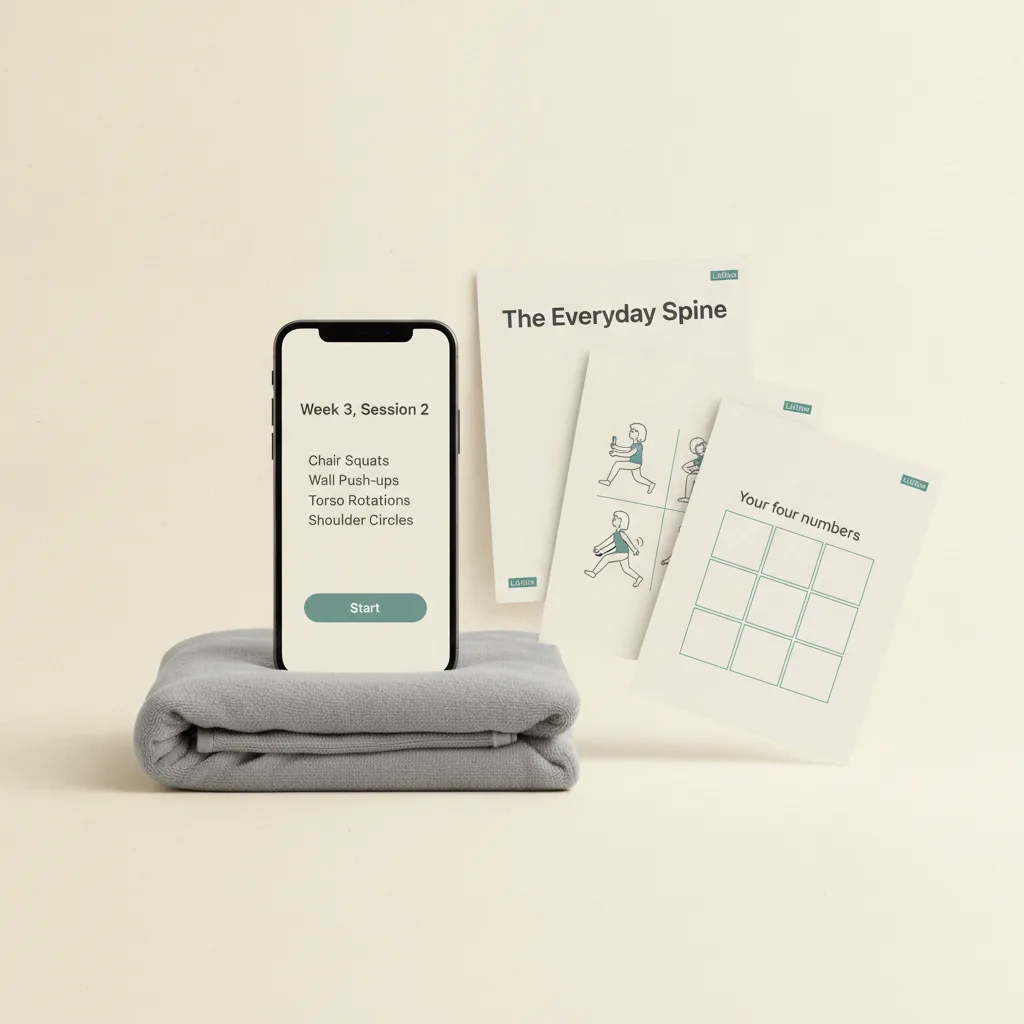
- Twenty-four sessions, written one at a timeTwo a week for twelve weeks, each one written out, with the reason for every change in it.
- No barbell, and nothing to buyA dining chair, a wall, a folded blanket and a bag of shopping. Nothing goes on top of your spine at any point in the programme.
- Getting up off the floor, taught properlyA fixed order, practised on a blanket next to a chair until your body knows it. Almost nobody teaches this and it is the difference between a fall that is embarrassing and a fall that is an admission.
- The app that explains itselfEvery session arrives with today's numbers filled in and a plain sentence saying why. One tap to log a set.
- The Doctor BriefingTwo printable pages written for your clinician rather than for you, with the citations on them and a space for her to sign.
- Never Do TheseThe three movements that stay banned for the whole twelve weeks, and the mechanics of exactly why.
Save $50.01 (74%). Goes back up to $67 on the first.
One payment. Nothing renews. Twelve weeks of program, yours to keep.
The guarantee
The guarantee is about Phase 1
Do Phase 1. Eight sessions over four weeks. If you do not feel measurably steadier at the end of it, tell me and I will refund every cent, and you keep everything.
Four weeks is the smallest amount of work that makes the question answerable. Thirty days with no requirement attached is a number chosen to be shorter than the time it takes to find out.
Before you decide
Questions
Everything people ask me before they start. If yours is not here, ask it before you buy rather than after.
Is there a subscription? Is there a supplement I have to buy?
No and no. No monthly charge, no auto renewal, nothing to swallow, and no equipment I earn a cent on. Every purchase here is one payment for something you keep.
I have already broken a bone in my spine. Is any exercise safe for me?
Yes, and the choice is not between exercise and rest. It is between the kind that loads the front of your spine and the kind that does not.
The three things that are genuinely dangerous for you are bending forward with weight in your hands, twisting with weight in your hands, and putting weight on top of your spine. Sit-ups, standing toe touches, and a loaded barbell across the shoulders. Those are out of this programme permanently and there is a page in the app explaining exactly why for each one.
What is left is a great deal. Lying face down and lifting your chest two inches. Standing up out of a chair. Sliding your arms up a wall. Standing on one foot at the sink. Holding a bag of shopping in one hand without leaning. None of those put a pound on top of your spine and all of them make you stronger.
The thing worth being clear about: this will not undo a bone that has already wedged. Nothing will. What it works on is the muscle that holds you upright, the shape you spend your day in, and how likely you are to go over. Those are the three parts that still respond, and the third one is the one that decides how the next ten years go.
If you have new pain, or pain that has changed, get that looked at before you start anything at all. That is not a formality and it is the one thing I will not budge on.
Do I need to buy anything?
A dining chair, a wall, and a folded blanket for the floor. You already have all three.
The only thing you might not have is something to hold in one hand for the carry, and a shopping bag with tins in it does that job perfectly. Weigh it once on the bathroom scale and put the number in the app.
Around week nine some women add a pair of two-pound ankle weights, which cost about twelve dollars and are entirely optional. I do not sell them and there is no affiliate link anywhere on this site.
That is genuinely the whole list. This is different from the other programme on purpose. Loading a spine like yours needs a barbell and needs supervision, and since you are not getting either, we are not doing the thing that needs them.
How is this different from The Threshold Protocol?
They are for two different women and they share almost nothing except the app they run in.
The Threshold Protocol is for a woman whose scan came back thinning and whose spine is otherwise sound. It says her walking and swimming never put enough force through her bones to be worth building for. The answer there is to lift heavy. Deadlifts, squats, presses, twice a week, going up.
That programme turns some women away at the checkout. A broken bone in the spine. A score at -3.0 or below. Stenosis. A doctor who has already said no. It turns them away because loading a spine like that with nobody in the room is the thing that hurts them.
The Upright Protocol is what those women get instead. Nothing goes on top of your spine, ever. The work is on the muscles that hold you up, on your balance, and on the way you move through an ordinary day. Those are the parts that still respond when heavy lifting is off the table.
Not sure which one you are? The other checkout asks about your health before you pay anything, and the answer routes you to the right programme before a cent moves.
Will this straighten me back up?
Partly, and I want to be precise about which part, because this is where most programmes make a promise they cannot keep.
A forward curve in the upper back is two things stacked on top of each other. One is the shape of the bones themselves, and if a bone has wedged, that part is permanent. No exercise reverses it and anybody telling you otherwise is selling something.
The other part is soft tissue. The muscles at the front of your chest get short, the ones across your upper back get weak and long, and between them they hold you further forward than your bones alone require. That part is not permanent, and on most women it is a bigger share of the total than they expect.
So what tends to happen over twelve weeks is that you stand somewhere between your current position and your bone position, which is often a visible difference and almost always a comfortable one. Several women have mentioned it was the neck ache going that they noticed first, rather than anything in a mirror.
What I will not do is put a number on it. It varies enormously and it depends on which of the two parts you have more of.
Am I too old for this? Am I too far gone?
No, and I want to be careful about why the answer is no.
The other programme on this site has a floor under it. It asks whether you can get off the ground unaided, and if you cannot, it turns you away. This one has no such floor, because the women it turns away are the women who end up here.
Every lying-down movement in these twelve weeks has a standing version, written out in full, and the app asks which you want before your first session. Week one of the chair path is you standing up out of a dining chair and sitting back down, four times, twice. That is the whole first movement. If that is hard, we start with a cushion on the seat to raise it, and the cushion comes out when it stops being needed.
Muscle responds to being asked for more at every age that has been studied, including in people in their nineties and including in people who start from a chair. Nothing switches off at seventy or at eighty. What changes is how fast it comes back and how little it takes to lose it again, which is an argument for starting today rather than an argument against starting.
"Too far gone" is usually a sentence about the scan. The scan is not the thing this programme works on. It works on the muscles that hold you upright and on how likely you are to go over, and both of those answer at any age.
If you can sit in a chair and stand up out of it with a hand on the arm, you can start this week.
How much time does this take?
Twenty to twenty five minutes, twice a week. That is it.
There is no long warm up, because nothing here gets heavy enough to need one. There is no standing around between sets waiting for your breath back. The sessions are short because they are built out of small movements done well, not big movements done carefully.
Two of the twelve weeks add a third short day. It runs about twelve minutes and it is balance work only, done at the kitchen sink while the kettle boils. It is optional and the app will tell you so.
If twenty minutes is more than you have on a given day, do the first two movements and log it. A short session logged beats a full session skipped, and the app will not scold you for either.
I cannot get down on the floor. Can I still do this?
Yes. The programme has two complete paths, the floor and the chair, and the app asks you which before your first session.
On the chair path nothing asks you to lie down. The three lying-down movements run standing instead: the chest lift is done tall against a wall, the hip lift standing at the kitchen counter, and the bird dog leaning on the counter with your feet walked back. Each one is written out in full, with its own cues, its own common faults and its own drawings, and your sessions only ever show the version for your path.
One honest sentence before you decide, because you deserve it before paying rather than after. The lying chest lift is a slightly stronger dose than the wall version, so if lying face down is comfortable for you, pick the floor. The chair path is for the body that cannot, and it is the whole programme done a different way, not a consolation.
Getting down and up off the floor is not a requirement of this programme. It is one of its outcomes. There is a session in week nine that teaches it as a fixed sequence, with a chair beside you the whole time, down as many rungs as are available to you that day. Plenty of women who choose the chair path in week one are practising that sequence by the end of the twelve weeks.
You can switch paths at any point, in either direction. Open your Account page and look for the line called "Lying-down movements", then press change. Nothing you have logged is lost when you do.
Will it hurt? I am frightened of making my back worse.
That fear is not irrational and I am not going to talk you out of it. I am going to tell you what the programme does about it.
Three things break a spine like yours, and all three are out of this programme permanently. Bending forward with weight in your hands. Twisting with weight in your hands. Putting weight on top of your spine. No sit ups, no toe touches, no bar across the shoulders, not in week one and not in week fifty two. There is a page in the app on each one, explaining what it does to the front edge of the bone and why the answer never changes.
What is left does not put a single pound on top of your spine. Lying or standing and lifting your chest. Standing up out of a chair. Sliding your arms up a wall. Standing on one foot. Carrying a bag in one hand without leaning towards it.
Muscle soreness is normal and it is dull, it is spread over an area, and it is worse the day after tomorrow than tomorrow. Sharp pain is not normal. Pain down a leg is not normal. Pain that is worse the next morning than it was during the session means the last session was too much, and the app has a button for that which moves you back a step without you having to work out how.
And the honest part. Being careful has a cost too, and nobody puts it in a leaflet. Muscle that is not asked for anything gets weaker, and weaker muscle is what turns a stumble into a fall. Doing nothing is not the safe option. It is just the option where the damage is slow enough to blame on age.
I already did physical therapy. How is this different from the sheet they gave me?
The sheet was not wrong. It was unfinished, and it was unfinished for a reason that has nothing to do with the person who wrote it.
You got six visits, or eight, because that is what was approved. The exercises on that sheet were chosen to be safe for you to do alone at the level you were at in week one. Then the visits ran out, and the sheet did not change, and you kept doing week one for eleven months. Ten repetitions of the same thing, at the same difficulty, for a year.
Muscle only gets stronger when it is asked for more than it did last time. A movement repeated at the same difficulty stops producing change once the body has adapted to it, which usually takes a few weeks. That is the whole difference. Your sheet has no next week on it.
This has twenty four sessions in order, and each one is measurably harder than the one before it in a way you can see. Not heavier, because nothing gets heavy. Longer holds. Fewer hands on the chair. A slower way down. A narrower base under your feet. The app tells you what changed and why it changed it, in a sentence, every session.
Bring the sheet if you like. Most of what is on it is in here somewhere, sitting in week two.
I use a stick, and I have already had a fall. Is this still for me?
It is more for you, not less. Falling is the thing this programme is aimed at, and a fall you have already had is the strongest reason in the world to start.
Every balance movement in here is done holding something. Week one is both hands on the back of a chair. Week four is one hand. Week eight is one fingertip. Week eleven is the fingertip hovering half an inch off the wood, which is not the same as no hand, and the difference matters because you can put it back down in a tenth of a second.
Nothing in this programme ever asks you to let go and hope.
The stick stays. Nobody here is going to tell you to give it up, and if anyone does it should be the person who prescribed it, standing in front of you. What tends to happen is that women use it in fewer places, and they notice that rather than being told it.
There is one thing to sort out before session one. If your fall was recent, or if you fell without knowing why, that gets looked at first. A fall out of nowhere can be blood pressure, or medication, or your inner ear, and none of those are things a training programme can fix. Get that answered, then come back.
I have spinal stenosis, spondylolisthesis, or a fusion. Does that rule me out?
Those three are exactly why this exists. They are on the list that stops the other programme, and that list is what sent most people to this page.
Stenosis. The narrowing is usually worse when you arch backwards and easier when you round slightly forwards. So the chest lift in here has a range you set, and the instruction is to stop at the point where anything starts travelling down a leg, and to treat that point as your ceiling for the week rather than as a failure. Walking-tolerance work is done holding a counter, not on a treadmill you cannot lean on.
Spondylolisthesis. One bone in your spine has slid forward on the one below it. The thing that provokes it is arching hard under load, and there is no load in here to arch under. What helps is the deep abdominal and hip work that stops the segment moving around, and that is in weeks one through four before anything else starts.
A fusion. The fused levels do not move, which means the levels above and below do more than their share. Everything here is about what the rest of you is doing so those neighbours are not carrying it alone. If your surgery was in the last six months, wait, and the checkout will stop you.
None of this replaces the person who diagnosed you. Take the Doctor Briefing to them. It states in two pages what this programme does and does not do, and it turns "should I be exercising?" into a question they can actually answer.
I am on alendronate, Prolia, Forteo or Evenity. Does this replace it?
No. Do not stop anything, and do not delay anything, on account of this programme.
I have no view on your medication and I am not qualified to have one. That conversation belongs to you and the person who prescribed it, and nothing on this website is a reason to reopen it.
What is worth understanding is that the two do different jobs. Your medication works on the bone. This works on the muscle that holds you up and on whether you go over in the first place. A drug cannot make you catch yourself on the stairs, and standing on one foot at the sink does not change what a scan says. You are allowed both, and most women here have both.
One practical note. If you are on a drug that is given as an injection on a schedule, do not let it lapse without talking to your prescriber. Some bone medications have a rebound effect when they are stopped abruptly, which is a specific medical issue and not something a training programme can manage. That is a real thing, it is theirs to handle, and I mention it only so nobody reads a page about exercise and quietly decides they are done with the pharmacy.
How fast will I feel anything?
Sooner than the other programme, and for a different reason.
Strength takes weeks. Balance and coordination move faster than that, because a lot of what makes you unsteady is not weakness at all. It is your body having stopped practising. Practice comes back quickly.
Weeks one and two feel like nothing is happening. Everything is deliberately too easy and you will suspect you have been sold something trivial. That is the ramp, it is on purpose, and it is the part most women want to skip.
Somewhere in weeks three and four is when it usually lands, and it is almost never dramatic. Standing up out of a chair without a hand on the arm, and noticing an hour later that you did. Reaching into the top cupboard without rehearsing it first. Turning round in the kitchen without the small pause.
By week eight the balance number is the one that has moved most. Standing on one foot at the sink for as long as the kettle takes is a normal week eight.
And what will not happen: nothing you feel in twelve weeks is bone. This does not change what your next scan says and I am not going to suggest otherwise. What it changes is what you can do between now and then, and how likely you are to be on the floor at some point in the next ten years.
What is the guarantee, and how does the refund work?
Do Phase 1. Eight sessions over four weeks. If you do not feel measurably steadier at the end of it, tell me and I will refund every cent, and you keep everything.
I tied it to finishing Phase 1 rather than to a date on the calendar, and the reason is not cleverness. Thirty days with nothing attached rewards the woman who buys, does nothing, and asks for her money back on day twenty nine. Eight sessions is four weeks, it is about three hours in total, and it is the smallest amount of work that makes the question answerable at all.
Phase 1 also ends with numbers. How long you held the chest lift. How long on one foot. How many chair stands in thirty seconds. You are not deciding on a feeling, you are looking at week one next to week four.
If the question before payment routes you out, you do not have to ask anybody for anything and there is nothing to refund, because I would rather not take the money.
What this is not is a thirty day trial. If you get part way in and something is genuinely in the way, tell me what it is. Half the time it is a position or a swap I can sort out in one reply, and I would rather sort it than take your money for nothing. If I cannot, the money comes back. If you simply have not started, the promise above is the one I am making, and it is waiting for you at session eight.
What exactly do I get for the money?
sixteen dollars and ninety-nine cents, once, for the following.
- Twenty four sessions across twelve weeks, written out one at a time. Two a week. Not a template you fill in yourself.
- Both paths written in full: the floor path and the chair path. The app asks you once, before your first session, you can change your answer whenever you like in Settings, and you never see the version you did not pick.
- The getting up off the floor module in week nine, taught as a fixed sequence next to a chair. Almost nobody teaches this and it is the single most useful thing in here.
- The app. Every session opens with today's numbers already filled in and a plain sentence saying why they changed. Logging is one tap. At the end it shows you today against week one, because no scan is going to show you what four weeks did and you deserve to see something.
- The four numbers. A written assessment at the start and at the end: chest lift hold, one foot hold, chair stands in thirty seconds, and how far you can reach without moving your feet. Printed, so next year is a comparison rather than a memory.
- Never Do These, which is the three movements that break a spine like yours, with the reason for each one.
- The Doctor Briefing, two printable pages with the citations on them, written to be handed across a desk rather than read by you.
At checkout there is one unchecked box for The Everyday Spine at fourteen dollars and forty-nine cents. That is the thirty movements of an ordinary day taken apart one at a time: how to pick something up off the floor, how to get out of a car, how to make a bed, how to carry shopping, how to cough. It is optional and the programme is complete without it.
For scale. One session with a physical therapist runs $150 to $250, and you would need a dozen to cover this ground. The scan that gave you the news cost more than this does.
What happens after the twelve weeks?
You keep everything, and the honest answer is that you keep doing it.
This is not a course you finish. Muscle and balance are held by use. Stop asking for them and they go back, and they go back faster after sixty than they did before it. That is not a sales line, it is the reason the twelve weeks end with a maintenance week written out rather than with a certificate.
Week twelve gives you two things. Your four numbers, written down, so a year from now you are comparing rather than guessing. And a two-session week you can repeat indefinitely, which is the smallest amount that holds what you built.
Plenty of women just run the twelve weeks again from the start at the level they finished on, and that works.
There is a longer continuation if you want it, and you will be offered it once. It is not required, nothing renews, and if you never buy another thing from me the programme you have does not expire, does not lock, and does not start nagging you.
My doctor told me to be careful. What do I tell her?
Show her the Doctor Briefing. It is free, it is two pages, and you do not have to buy anything to get it.
"Be careful" is usually the correct answer to a question nobody had time to ask properly. In a ten minute appointment, "should I exercise?" from a woman with a spinal fracture sounds like "should I go to a gym and lift weights?", and the safe answer to that question is no. She is not being lazy. She is answering what she heard.
The briefing changes what she is answering. It states in plain terms that there is no axial loading anywhere in the programme, that bending forward and twisting under load are excluded permanently, that the work is extensor endurance, hip strength, and balance, and it lists the conditions that stop it. There is a line at the bottom for her to sign if she wants to.
Given that, the answer often changes, because it is a different question.
If it does not change, that is her call and it stands. She has seen your images and I have not. Ask her what specifically she wants avoided, because "be careful" is not a plan and you are allowed to ask for one.
One thing that is not up for discussion: if you have new pain, or pain that has changed, or you fell without knowing why, that comes first and this comes second.
Do I need somebody in the room with me?
No, and the programme is built on the assumption that you are alone, because most women reading this are.
That assumption shapes what is in it. Nothing here requires a spotter, because nothing here is heavy enough to need catching. Every balance movement is done next to something solid you are already holding, and the progression is how much of your weight is in that hand, never whether the hand is there at all. Nothing asks you to hold a position you cannot get out of on your own.
The floor module in week seven is the one place a first go with somebody nearby is worth having if that is available to you. Not because it is dangerous, but because the first time down is easier when you are not also managing the thought of getting back up. If nobody is available, it is done next to a chair, in a fixed order, and the app walks you through it a step at a time.
Two practical things, and then I will stop. Have your phone in the room, not in the hall. And if you live alone, tell one person which two mornings you train. That is not about this programme. That is just sensible, and you probably already do it.
My fracture was recent. How long do I have to wait?
Ask the person treating you, and do what they say. I am not going to put a number on this page that somebody uses instead of an answer from someone who has seen their images.
What I can tell you is what the question actually is, so you can ask it properly.
A broken bone in the spine that is settling is a different situation from one that is still painful and still changing. The thing your clinician is watching for is whether the bone is stable. Until it is, even gentle work waits, and the honest reason is that nobody can tell from here.
So the question to ask is not "can I exercise yet?" It is: "Is my fracture stable, and when it is, is extensor endurance and balance work without any axial load appropriate for me?" That is a question with a real answer. The Doctor Briefing is written to be handed over at exactly that appointment, and it is free.
In the meantime, do not lie still for weeks waiting for permission. Long stretches of bed rest after a break like this cause muscle and bone loss of their own. Walking as tolerated is usually part of what you have already been told to do. Do that part.
And the checkout will stop you if you have had surgery in the last six months, or if there is pain nobody has looked at yet. That is not a permanent no. It is a wrong-order problem, and this will be here at the same price when the order is right.
Can I buy now and start later?
Yes. Nothing you buy expires. The programme sits in your account until you open it, and a session you have not started does not count down. Buying in September and starting in November is fine, and the price you paid is the price you paid.
Two things are worth knowing before you go quiet for a while.
The rest gap between sessions runs from your last logged set, not from the day you bought. So if you stop for three weeks, the next session is waiting when you come back, and nothing sends you backwards. You pick up at the session that was next.
The guarantee is linked to finishing Phase 1 and it has a time limit from the day you buy, which is printed on the refund page. If your plan is to buy now and start months later, that limit can run out before you have done eight sessions. If that is you, say so in one line to support when you buy, on the same email thread, so the date you told us about is on record. That thread is what the guarantee is read from if you ever need it.
Two versions of the next twelve weeks
The first one. You close this page and carry on being careful, because being careful is what everybody told you and it is what you have been doing and nothing bad happens this month.
The circle round the things you will not do gets a little wider each year. The grabber, then the stair rail, then the shower rail. You stop driving at night. You stop going to the things where the pavements are uneven, and then to most of the things.
And somewhere in there the spiral does what spirals do. Another one, usually from something that should not have been enough to do it. Reaching into the boot of a car. A cough. Nothing at all.
I am not saying that to frighten you. You have been frightened for a year already and it has not helped. I am saying it because being careful is not a neutral choice and somebody should have told you that.
The second one. Tuesday morning, on your bedroom floor, lifting your chest two inches for five seconds.
By week four you get out of a chair without putting a hand down and notice an hour later that you did. By week eight you can stand on one foot at the sink for as long as the kettle takes. By week ten you get down onto the floor and up again, on purpose, in an order your body knows.
And the thing that changes is not on a scan.
You stop being the person everybody helps. You stop rehearsing every reach before you make it. You go to the thing with the uneven pavements, because you have twelve weeks of evidence that you can catch yourself.
And you become the other one. The woman who gets down onto the garden bed with her grandchildren and back up again without a plan for it, while her daughter, who has spent two years watching her on the stairs, notices and says nothing, because there is suddenly nothing to say.
I cannot promise you a number. What I can tell you is that being careful was never the whole answer, that the muscles which hold you up will get stronger at any age if something asks them to, and that nothing in these twelve weeks puts a single pound on top of your spine.
Twelve weeks. Twenty-four sessions. sixteen dollars and ninety-nine cents, once.
You have been careful long enough.
Stand up straight.
Save $50.01 (74%). Goes back up to $67 on the first.
One payment. Nothing renews. Twelve weeks of program, yours to keep.
P.S. If you take one thing from this page and never buy anything, take this: stop doing sit-ups and stop doing standing toe touches, today, permanently. Bending forward with weight in your hands puts the load on the exact edge of the bone that gives way. That advice is forty years old, it is free, and it applies to you tonight.
P.P.S. If you are in new pain, or pain that has changed, that comes first and this comes second. Get seen. Then come back, because the programme will still be here and you will still need it.