For women who were told to walk more
Thirty years of swimming, walking or the bike, and your scan came back thinning anyway. 63% of competitive road cyclists have thinning bones. Only 19% of runners do.
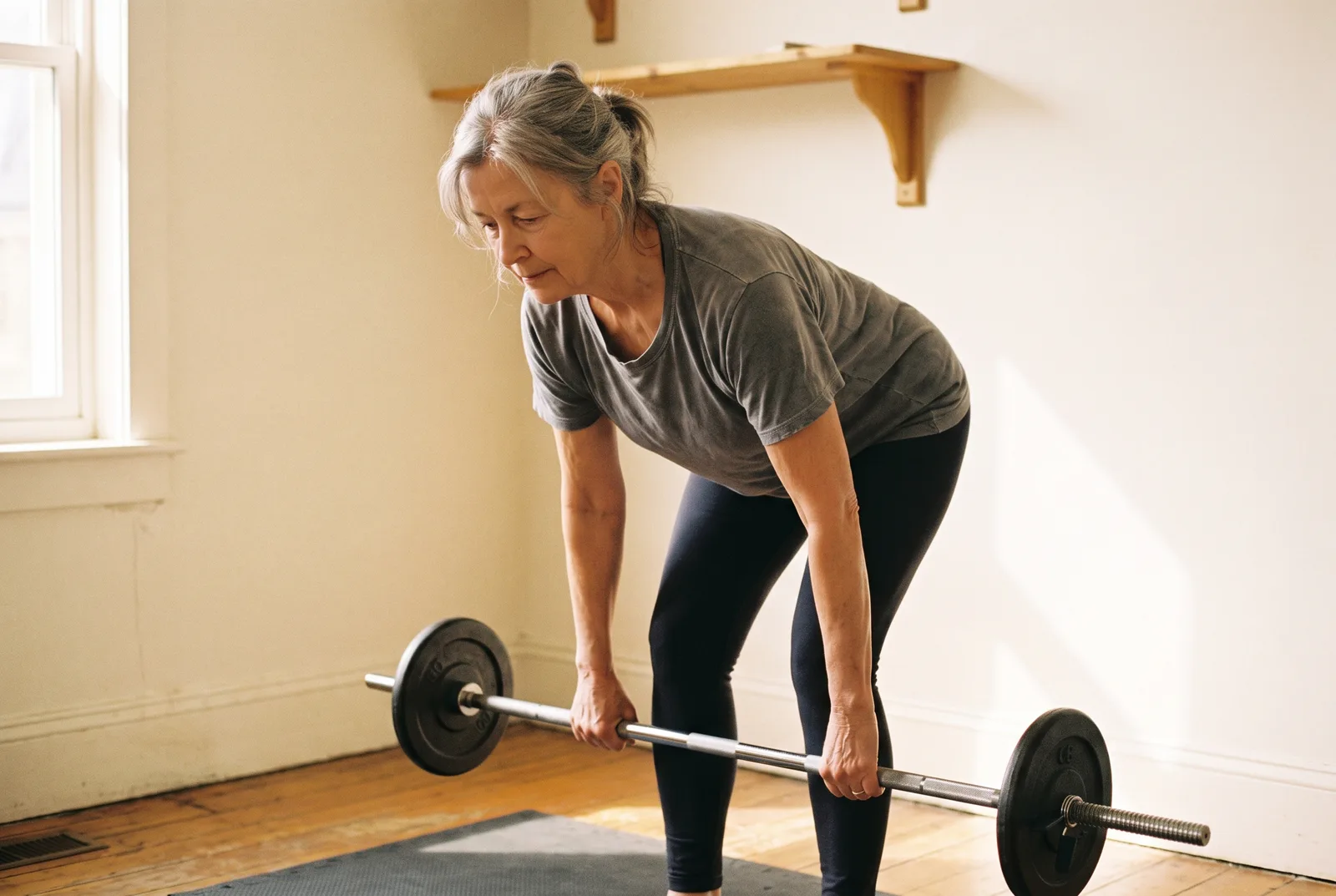
Bone only rebuilds in response to real physical force, and walking, swimming, and yoga don't supply enough of it, no matter how many years you put in. Twelve weeks of the right kind of loading does, and your own strength numbers move by week four, whatever your last scan said.
I have spent 22 years putting people back on their feet after breaks and surgery, and those two numbers still stopped me. When I finally understood the gap between them, I understood something worse. Almost everything women your age are told to do for their bones sits on the wrong side of it.
You are past menopause. Somebody handed you a DEXA result you did not see coming. Osteopenia, or osteoporosis, or just a number with a minus in front of it that nobody sat down and explained. And the exercise you have done faithfully for the last twenty or thirty years is walking, or swimming, or the bike, or yoga. Which is exactly why the number makes no sense to you.
If that is you, read all of it. It takes about twenty-five minutes, and it will change what you do on Tuesday.
This is for you if
- A scan came back saying your bones are thinning, and you did not see it coming
- You are past menopause
- You have walked, swum, cycled or done yoga faithfully for years
- Nobody has told you what to do about it beyond calcium and be careful
Already broken a bone in your spine, or scored -3.0 or below? Then loading is not safe for you unsupervised, and there is a different programme for that. It is here.
Who is telling you this
I am a physical therapist. 22 years of it, most of them helping people get back on their feet after injuries and surgery, and the last stretch in a bone health clinic where the same conversation happened four times a day.
A woman comes in holding a scan result. She is somewhere between fifty-five and seventy. She is not unwell. She is often fitter than everyone around her. She swims. Or she cycles. Or she has done yoga twice a week since her children left home. Or she walks four miles most mornings and has the shoes to prove it.
And the paper in her hand says her bones are thinning.
She says the same sentence every time. I do everything right. How is this happening to me?
For a long time I gave her the answer I was trained to give. Calcium. Vitamin D. Weight-bearing exercise. Keep walking.
She would nod. She would go away. She would come back in two years with a worse number, having done every single thing I told her.
It took me an embarrassingly long time to work out that the problem was not her.
It was my advice.
Physical therapist, twenty-two years in orthopaedic and bone health rehabilitation.
What nobody warns you about is the six months after
The result does not arrive with any ceremony.
It is a message on a portal at nine at night. Or a letter. Or four minutes at the end of an appointment about something else, and a leaflet, and the next patient waiting.
And then you are standing in your own kitchen holding a piece of paper that says the frame you live in is not as solid as you thought it was.
Here is the strange part. Nothing hurts.
There is no ache to point at. No swelling, no limp, nothing you could show anyone. You feel exactly the same as you did the day before you knew.
But something changes anyway, and it changes fast.
You start holding the rail. Not because you need it. Because a voice in the back of your head started keeping score, and it never quite stops.
You look at the ice on the front step differently. You used to just walk out. Now you stand at the door for a second and work out where to put your feet.
Your grandson puts his arms up to be lifted and there is a half second, before you pick him up, where you think about your spine. He does not notice. You do.
You stop saying yes. The walking holiday in the spring. The ski trip everybody is planning. Standing on a chair to get the Christmas boxes down. Small things, one at a time, and none of them feel like a decision. They just quietly stop being things you do.
And you are mostly going through this on your own.
Your husband says you are the fittest person he knows, and he means it kindly, and it lands like nobody is taking this seriously. A friend says take more calcium, in the same voice she would use about a cold. Your doctor gave you four minutes and a leaflet.
The word itself does not help. Say "osteoporosis" out loud and everybody pictures a frail old woman with a walking frame. You are not that. You went to a spin class on Saturday. So after a while you stop bringing it up at all, and it just sits there in your chest, on your own, at eleven at night.
And underneath all of it, most of the time unsaid, is one particular memory.
Your mother. Or your aunt. Or the woman two doors down. She fell. It was nothing, a kerb or a wet floor. She went into hospital. And she never came home to the same house again.
That is not being dramatic. That is the thing you are actually afraid of, and you are right to be afraid of it, and nobody in this whole process has said it out loud to you.
So let me say it. That is what we are talking about. Not a number on a page. That.
And then let me tell you why the number happened, because it is not what you think, and it is fixable.
Four things this page answers before it asks you for anything:
- Why some of the strongest women tested had some of the weakest bones in the building
- What thirty years of walking, swimming or yoga sends to a skeleton, and what it does not
- The trial nobody expected to be allowed, and what it did to the women in it
- Why the word on your scan letter is not the instruction most women think it is

Start with the swimmers
There is a group of women whose whole adult lives have been exercise. Six mornings a week in the pool since they were twelve. National squad, then Olympic squad. Lungs and legs most of us cannot imagine owning.
Scan their hips.
Bellver and colleagues measured bone density in elite female swimmers and found it no better than in women who do no sport at all. Not slightly worse than expected. The same. As people who do nothing.
Another group found swimmers about 9.8 percent below non-exercisers in the bones of the legs, and the endurance swimmers about 14.8 percent below.
Worse than sitting still. In the legs of an Olympian.
I did not believe it the first time I read it. So I went looking for the same pattern somewhere else, and I found it straight away in cyclists.
Medelli and colleagues scanned a professional road cycling team and found that roughly two thirds of the riders had bone density below the normal range. Andersen and colleagues scanned nineteen elite Norwegian endurance cyclists. Ten had low bone density and one already met the criteria for osteoporosis.
Professional athletes. In their twenties and thirties.
Then the number that finally made it click.
Pooled across the research, about 63 percent of road cyclists show thinning bone. In runners it is about 19 percent. The usual explanation is that a cyclist's skeleton carries roughly half the loading history.
Sixty-three and nineteen.
Sit with those two numbers, because runners are the control group nobody planned. Same hours. Same discipline. Same obsessive people, near enough the same lungs.
The only real difference is that a runner's skeleton gets hit by the ground several hundred times a mile, and a cyclist's does not.
So it is not fitness. It is not effort. It is not even hours.
Something else is deciding, and it is not paying the slightest attention to how hard you are breathing.

What is actually deciding
In 1987 a doctor named Harold Frost published the idea that explains all of it.
Here is the whole thing in plain words.
Bone is not a fixed frame you were issued at twenty-five and have been slowly losing ever since. It is torn down and rebuilt over and over, your whole life, in response to the force put through it.
That word, force, is doing all the work. Not movement. Not effort. Not calories. Force.
And bone only adds material when that force crosses a certain level. Below that level it does not simply fail to build. It gets rid of material it has no evidence you need.
Think of a thermostat rather than a bank account.
Your skeleton is expensive. Bone costs a lot to carry and a lot to maintain, and your body is ruthless about things that cost it money. So it keeps a running estimate of how much bone you actually need, based on the hardest thing you have asked it to do lately.
Ask it for something hard and it builds. Never ask, and it quietly downsizes.
It is not broken when it does that. It is doing its job.
Which is why the swimmer's legs are the way they are. Water holds her up. Her muscles work extremely hard and her heart works extremely hard, and her thigh bone feels almost nothing, because the whole point of water is that it takes the weight off. Thirty years of training, and that bone has never once been told it needs to be stronger.
The bike does the same thing. The frame carries her. Her legs push, but they push against pedals, and pedals give.
Here is where it stops being an interesting fact about athletes.
Cycling. Swimming. Yoga. Walking.
Those four are, by a mile, the most common exercise among health-conscious women between fifty and sixty-five. They are the four things every doctor, every magazine and every friend recommends.
All four sit at or near the bottom of the scale for the kind of force that tells bone to build.
Walking is the one that hurts to say out loud, because so many women have built a whole health routine on it.
Walking is genuinely good for your heart, your head, your blood sugar and your balance, and I am not taking it away from anybody. But your skeleton has been carrying your body weight at walking speed every day since you were about one year old. There is no news in it. Your thermostat learned to expect that decades ago and priced it in.
So think about the pool at twenty to six on a February morning. The car park still dark. The smell of the chlorine in your hair all day at work. Thirty years of that, and you did not skip it when it rained, and you did not skip it the year everything else fell apart.
You did not fail.
You were given instructions that were right for your heart and wrong for your bones, and you followed them faithfully for thirty years.
Those are two completely different things, and I need you to keep them separate. Because the woman who decides she failed usually stops. And stopping is the only genuinely bad outcome available here.
And then everybody blamed menopause
You have almost certainly been told this is a menopause problem, and that the drop started when your oestrogen did.
That is not quite what happened, and the difference matters enormously for what you do next.
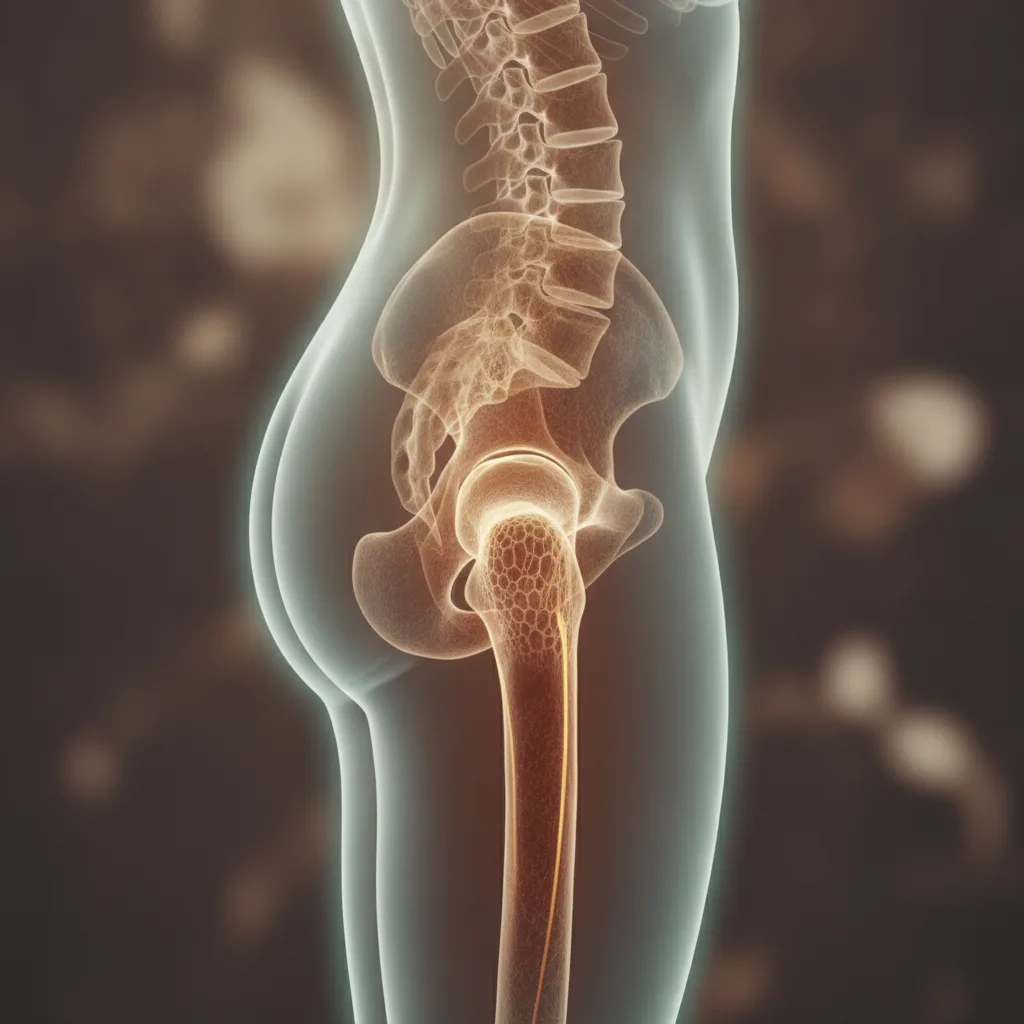
Oestrogen acts as a brake on bone breakdown. While it is there, it holds losses back. When it falls away the brake comes off, and losses that were being covered up become visible.
Menopause did not cause thirty years of missing force.
It revealed thirty years of missing force.
I know that sounds like splitting hairs. It is the opposite, and it is the most useful sentence on this page.
A problem caused by menopause is a problem you can only medicate.
A problem caused by a missing signal is a problem you can send the signal for.
At sixty. At sixty-eight. Starting from nothing.
The answer is not more exercise. It is a different signal.
The trial nobody thought would be allowed to happen
For most of my career, the advice for a woman with thinning bones was to be careful. Do not lift anything heavy. Protect your spine. Stick to gentle things.
Which, if Frost was right, is the exact instruction that guarantees she keeps losing bone.
We were telling women to turn the thermostat down and then worrying that the house was cold.
A research group in Australia decided to find out what happened if you did the opposite.
The trial was called LIFTMOR, published by Watson, Weeks, Weis, Harding, Horan and Beck in the Journal of Bone and Mineral Research in 2018. They took postmenopausal women who already had thinning bones and osteoporosis, the exact women everyone said must never lift, and put them under heavy weight.
Not gentle resistance bands. Heavy.
Five sets of five repetitions, at more than 85 percent of the heaviest weight each woman could lift once. Deadlift, overhead press, squat, plus some jumping and landing work. Twice a week. Thirty minutes a session. Supervised. Eight months.
My own reaction, reading the protocol, was that somebody was going to get hurt.
They measured real increases in bone density in the lower back and at the top of the thigh bone, where it goes into the hip.
Read that again. The spine and the hip.
The two places that matter most. The two places everyone had spent thirty years telling these women to protect by doing less. And the hip is the one from the story you already have in your head, the one about your mother and the kerb.
A second analysis of the same trial looked specifically at whether the heavy work had caused harm. It found no broken bones in the spine, and the forward curve of the upper back actually got better rather than worse.
Their posture improved. While lifting heavy. At an average age nobody would have believed.
Two things about that trial decide everything that follows.
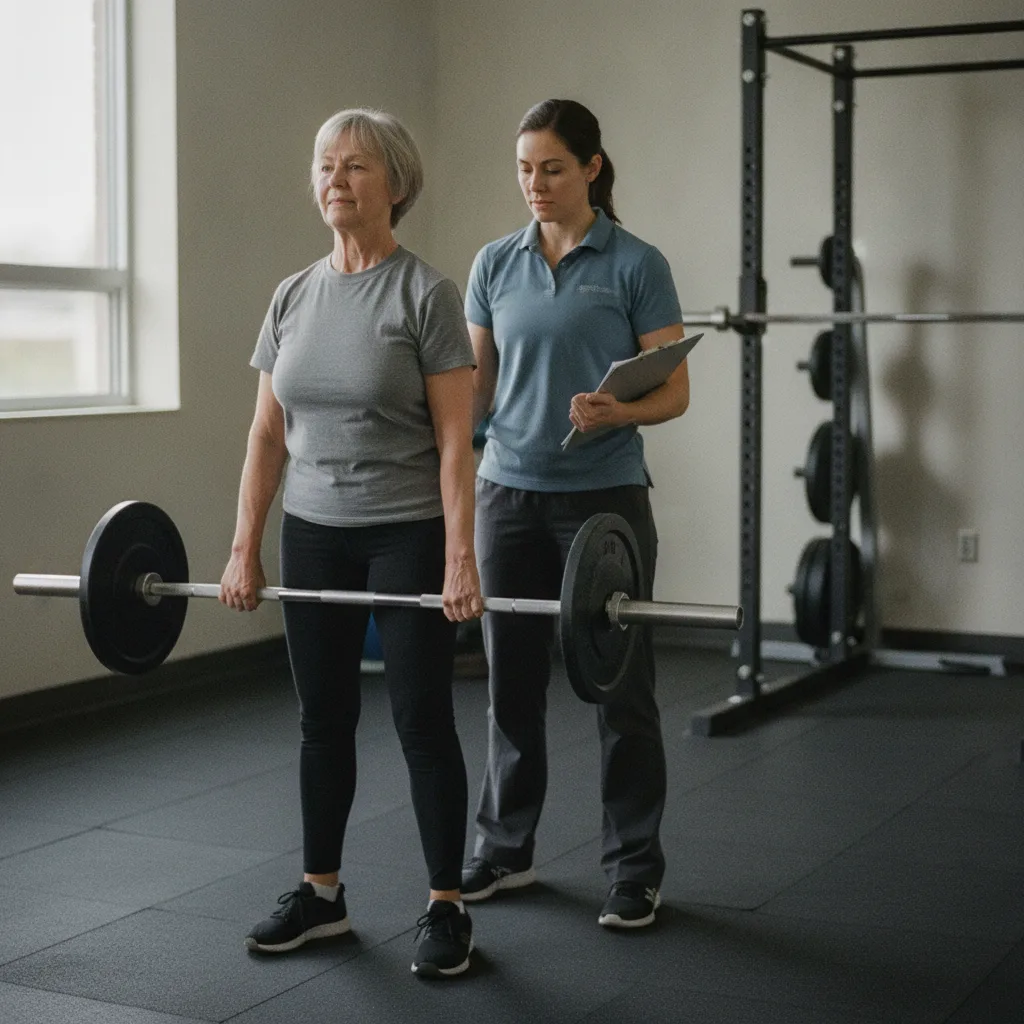
The first is that it was supervised. Every woman in it had a trained person standing next to her, every session, for eight months. That is not a footnote. That is most of why it was safe, and it is the whole problem I had to solve.
The second is that the numbers were real and they were not miraculous. Bone changes slowly, and eight months of twice-weekly training produced changes of a few percent. Anybody quoting you a bigger number has not read the paper.
The mechanism
Bone adds material in response to strain above a threshold, and ignores everything below it. Thirty years of walking sits below the line. That is the whole argument, and it is why the answer is not more exercise but a different signal.
Frost, 1987, the mechanostat. Watson, Weeks, Weis, Harding, Horan and Beck, 2018, Journal of Bone and Mineral Research.
What I built, and why it took so long
I could not send my patients to that trial. It was over, it was in Australia, and the version of it that exists in most towns is a personal trainer who has never worked with a low score and will be either too frightened to load you at all or not frightened enough.
So I spent a long time on one problem. How do you run that programme with nobody in the room.
The answer turned out not to be a video library. It is called The Threshold Protocol. Twelve weeks, twenty-four sessions, two a week, thirty to forty-five minutes each.
Phase 1, weeks 1 to 4. Foundation. Eight sessions at a weight you could carry up a flight of stairs. Four movements: hip hinge, squat, overhead press, row. Each session adds exactly one refinement, and only one.
Around session four you will notice you keep doing the same four things, and wonder whether you paid for four exercises. You did. The four movements are not the product. What they get loaded with, in what order, and the point at which you are allowed to go heavy, is the product. The repetition is the design. These four weeks are not the programme working. They are the programme becoming safe to run.
Phase 2, weeks 5 to 10. Crossing the Threshold. Twelve sessions. Three loaded lifts at five sets of five, one back exercise, and some light jumping work from week seven. This is where the weight finally crosses the line that matters, and where the signal actually starts being delivered.
Phase 3, weeks 11 to 12. Consolidation. Two heavy sessions, one deliberately light week that you will want to skip and must not, and a test that records four numbers you will measure next year against.
Three equipment paths, written out in full. Dumbbells at home, a barbell at home, or a gym. Not one programme with dumbbell swaps bolted on the side. Three, each written out session by session.
Most people do this at home with one pair of dumbbells, and that is the version I had in mind while I wrote it.
And if you own nothing at all, you can still start this week. That is the most common answer of the lot, so the app has a page for it: what to buy, what it costs, and what to lift in the meantime. The first four weeks are eight sessions of learning four shapes at a weight you could carry up a flight of stairs, which a loaded rucksack does perfectly well while your order is in the post. One pair of adjustable dumbbells, somewhere around a hundred and fifty dollars, is the entire shopping list. They go under a bed.
I will not pretend you can do this forever with no equipment. Your own body weight is the load your skeleton adapted to decades ago, which is the whole argument of this page, and lifting it again is not news to your bones. Anybody selling you a bodyweight programme for your bones is selling you the problem.
The dumbbell path has a ceiling too, and you should know where it is now rather than meet it by surprise. Somewhere around week eight your hips will be stronger than the heaviest pair you own, and at that point a barbell starts to matter. I do not sell barbells and I make nothing if you buy one.
The programme, at a glance
- What it is
- Twelve weeks of progressive lifting, the one signal bone actually responds to. Twenty-four sessions, three equipment paths, in an app that tells you what to lift and why.
- What it asks of you
- Thirty to forty-five minutes, twice a week, at home or in a gym.
- What you need to buy
- One pair of adjustable dumbbells, around $150, if you do not already have weights. That is the entire shopping list and I do not sell them. You can start this week with a loaded rucksack while yours are in the post, and the app has a page telling you exactly what to buy and what to lift until it arrives.
What you get for $16.99
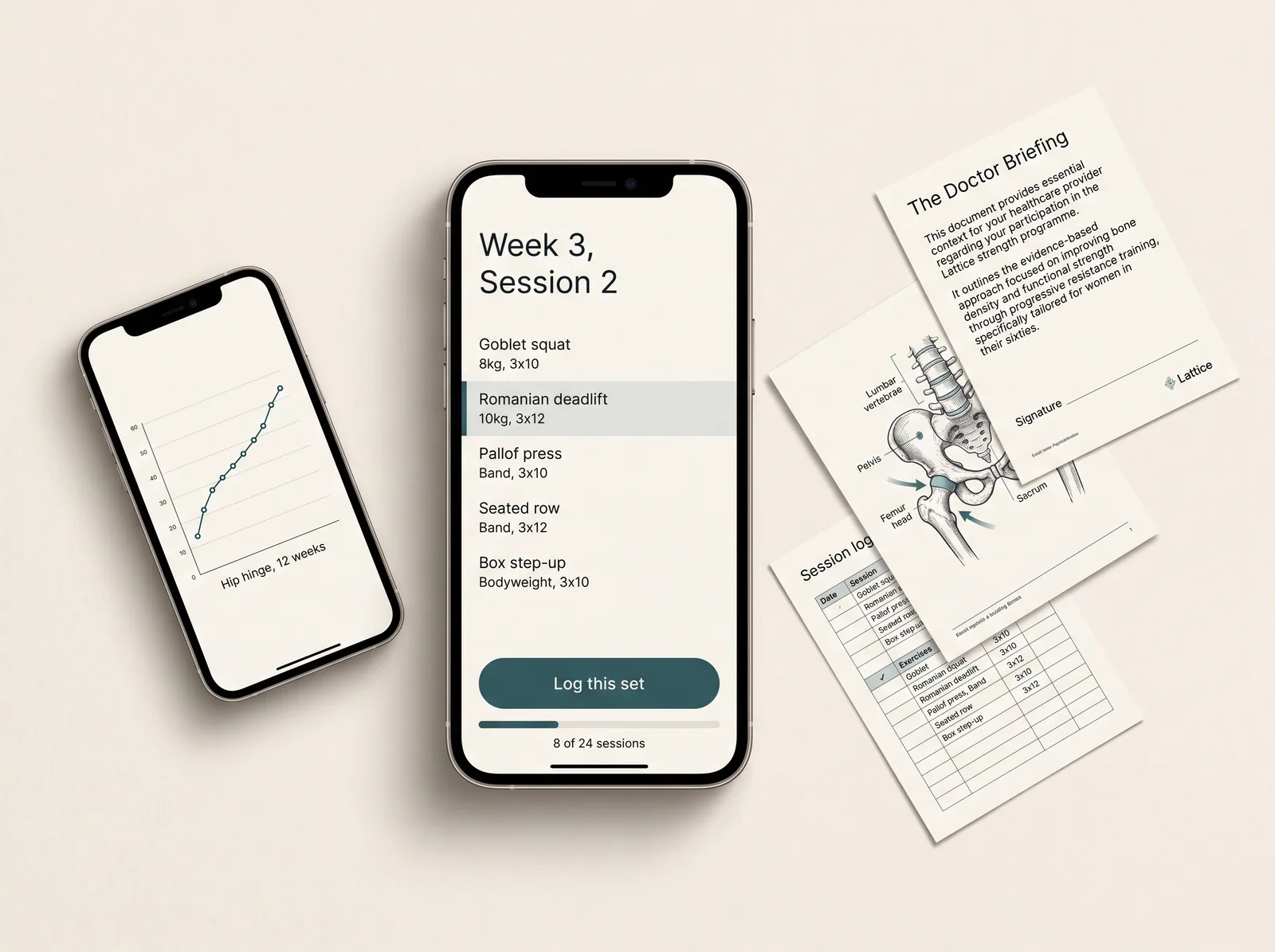
- 24 sessions across 12 weeksTwo a week, 30 to 45 minutes each. Written out one at a time, not a template you fill in yourself.
- All 3 equipment paths, in fullDumbbells at home, a barbell at home, or a gym. You pick one at signup and can change it later. Most women use one pair of dumbbells.
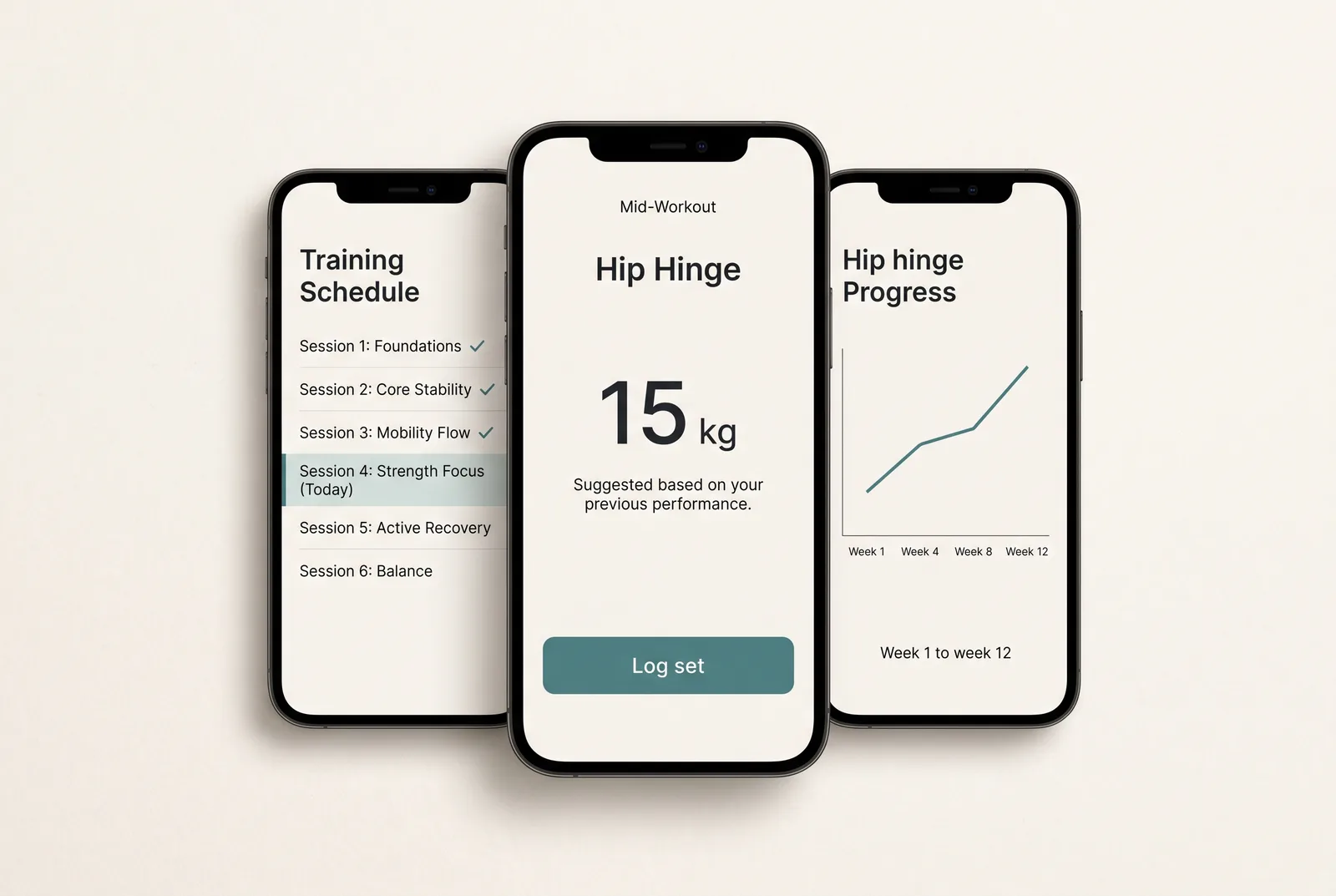
- The app that runs itEvery set arrives with a suggested weight and one plain sentence saying why it picked that number. Logging a set is one tap.
- The screening and the safety gatesEight questions that set your starting weights, your ramp length, and whether the jumping work is switched on at all.
- The Doctor BriefingTwo printable pages with the citations on them, written to hand across a desk rather than to read yourself.
- Never Do TheseThe three movements that break a thinning spine, and why, in plain words.
- The Rescan Primer and Reading Your Own ProgressThe two documents that stop you misreading your own scan results in either direction.
$16.99, once. Nothing renews.
No subscription to cancel. No supplement. No equipment you have to buy from me. At checkout there is one optional add-on, The Form Vault, for $14.49. The box starts empty.
Start here
Not sure this is about you? Answer the questions and find out.
Your scan result, what you have been doing, and what is honestly stopping you. At the end you get a version of this page written for the answers you gave, including the one answer that ends with me telling you not to buy anything.
Take the nine-question quizAbout two minutes · No email required · Nothing shared with anyone
You cannot see your bones. That is why women quit.
Your next scan is one to two years away. Between now and then you get no number, no signal, no feedback of any kind. Just the same question every Tuesday, asked in a quiet room with nobody to answer it: is any of this doing anything?
Women do not quit because the training is hard. They quit because it is silent.
So the app does one thing above everything else: it makes the progress you can see impossible to miss. Bone is invisible between scans. Strength is not, and it moves in weeks.
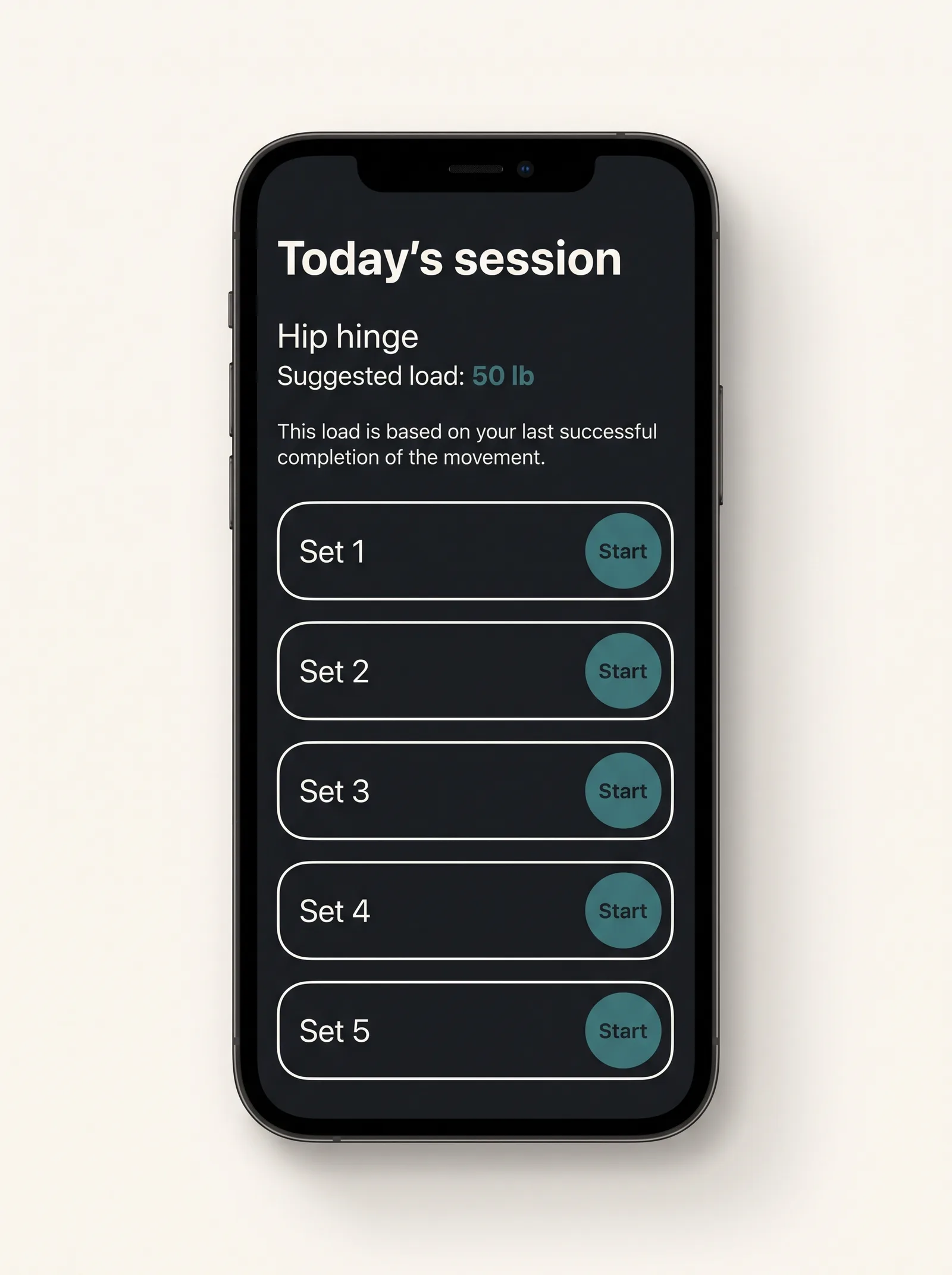
It tells you what to lift, and it tells you why. Open a session and the weight is already there. Underneath it, in plain words: "Last two sessions were solid at 45 lb, so try 50 today." Or, after a hard week: "The reps did not all land at 95 lb last time, so we stay there today rather than stacking a hard session on a hard one." It explains itself every single time. You are never guessing, and you are never being told what to do by something that will not say why.
Logging a set is one tap. The weight is filled in. The reps are filled in. If today matched the plan, you tap once and it is recorded. That sounds like a small thing. It is the difference between logging for twelve weeks and giving up in week three.
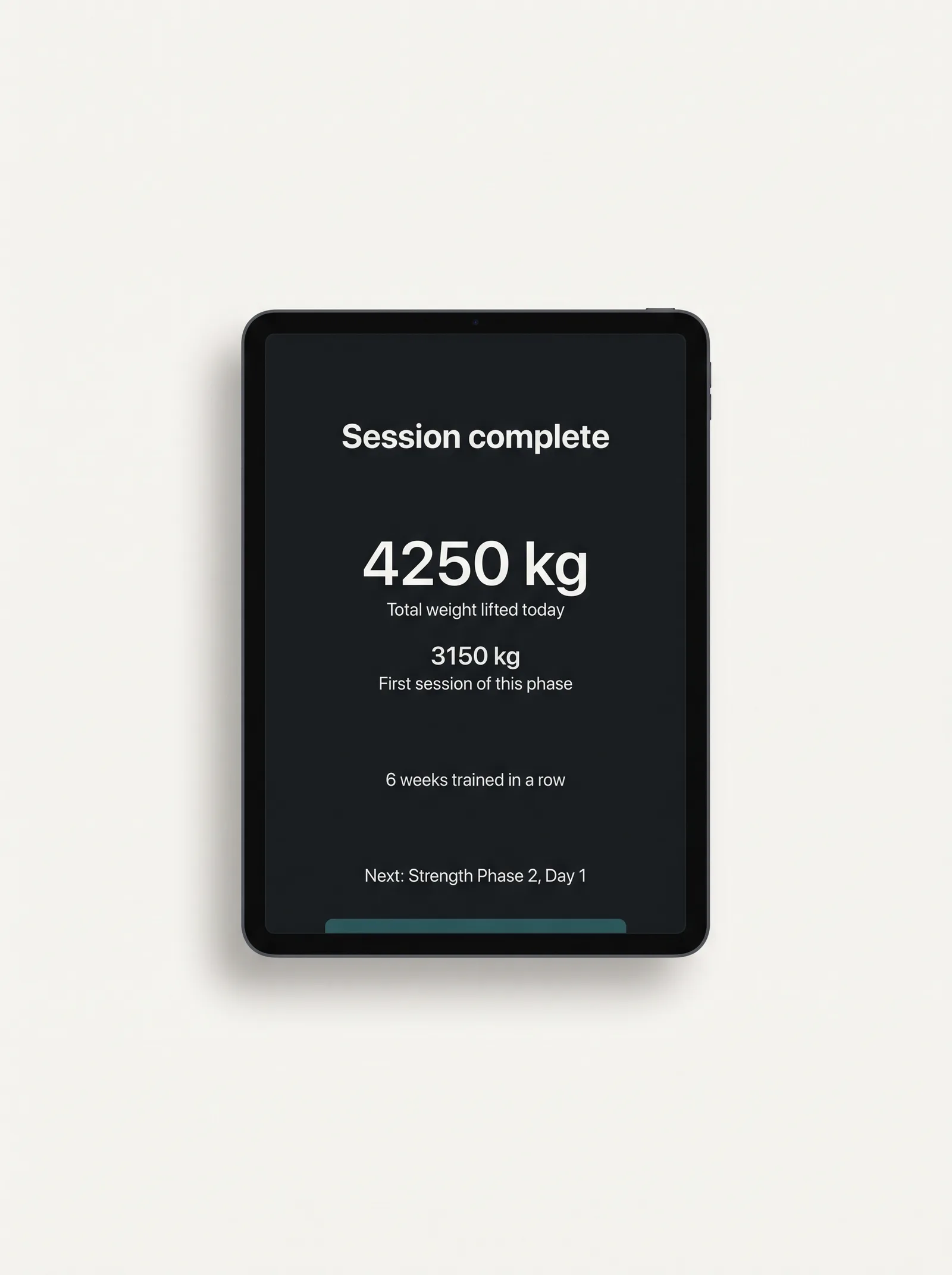
And at the end of every session it does the thing that carries you. It tells you what you moved today, and puts it straight up against what you moved the first time you did a session like it. Two thousand three hundred and forty pounds today. Eleven hundred and fifty in week five.
That number is not a badge. It is evidence. It is the only daily proof you can get that the signal is being delivered, and watching it climb is what gets a woman from here to a scan that is a year away.
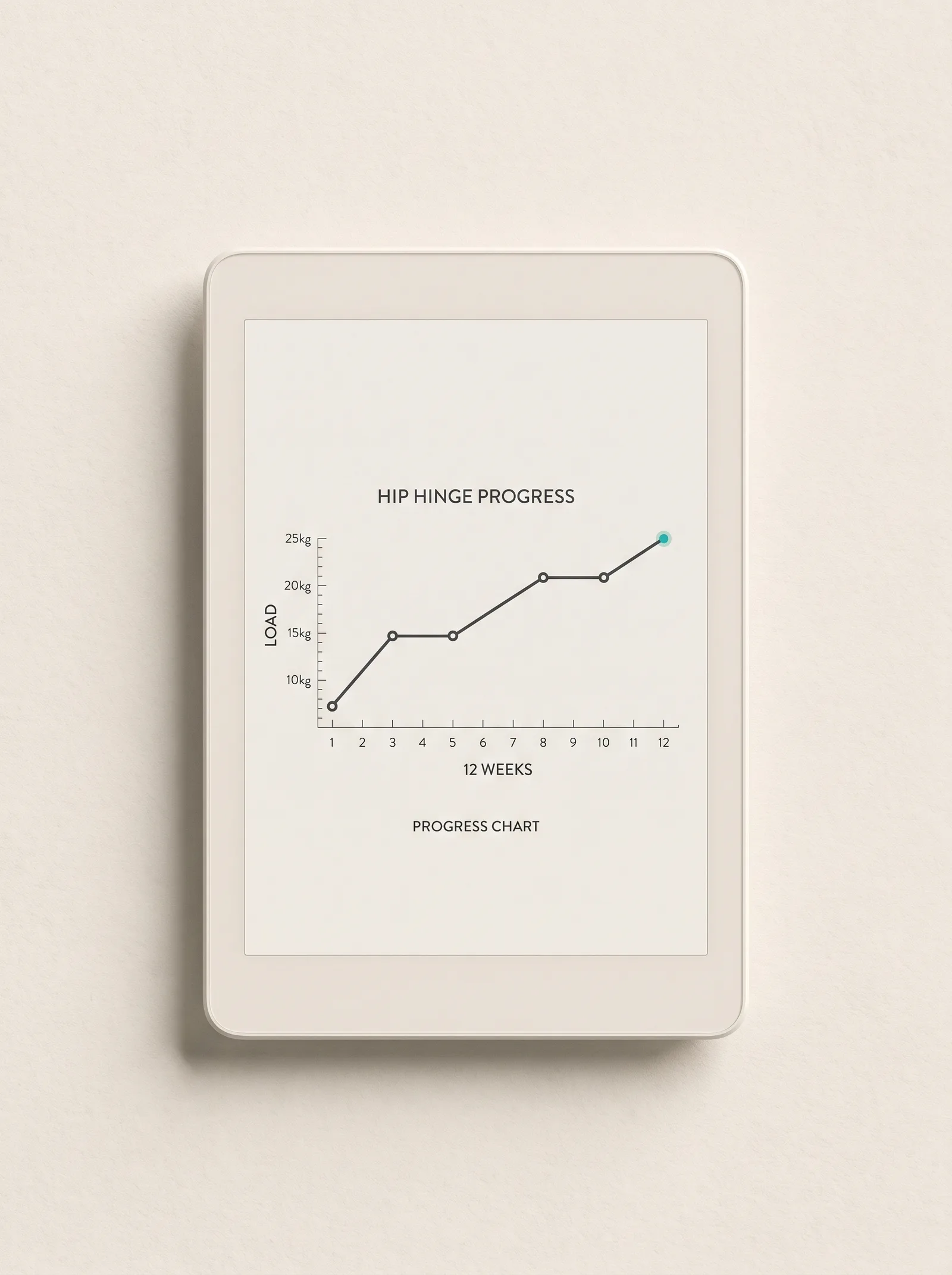
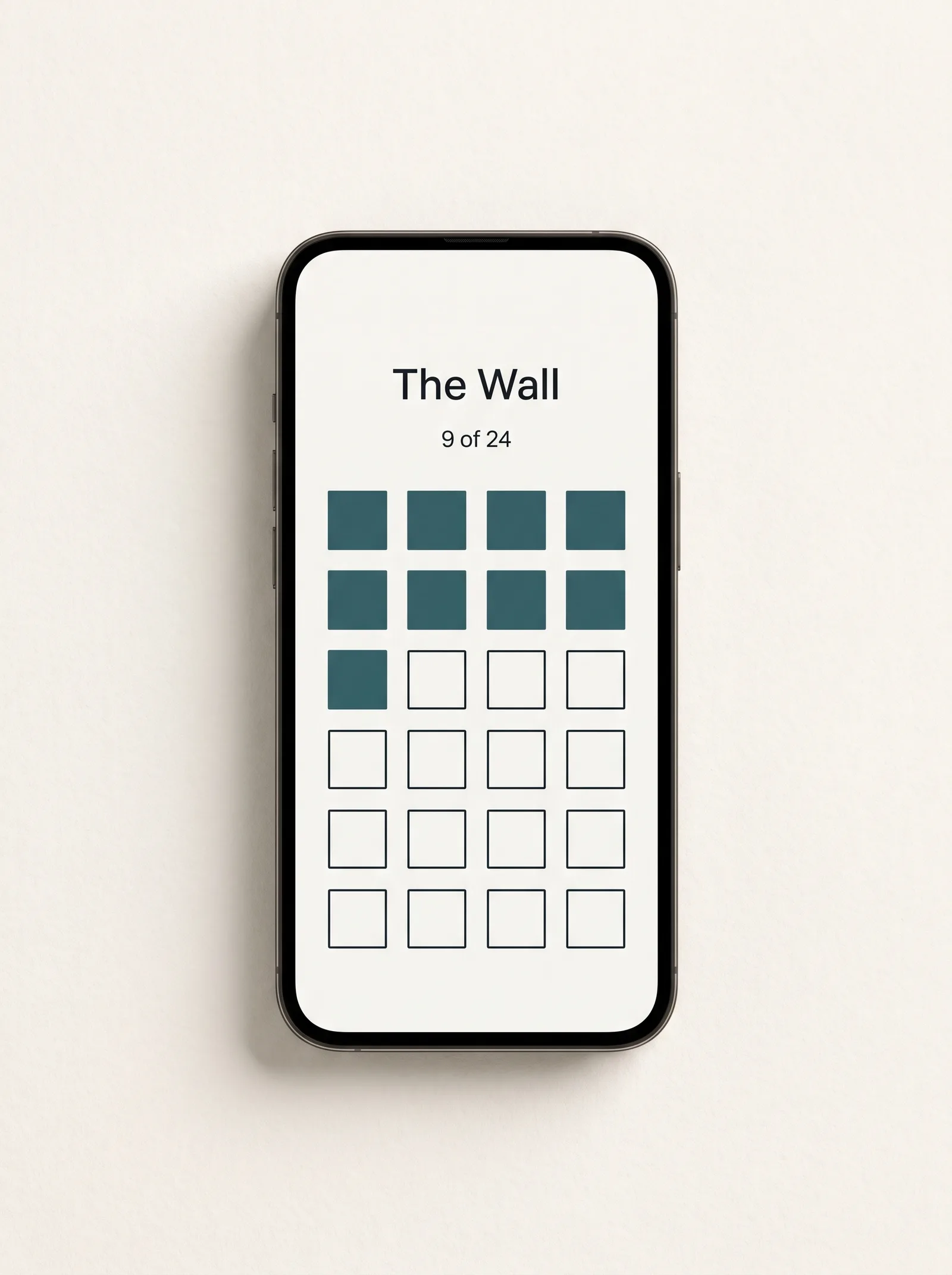
The Wall is twenty-four squares. One per session. Filled in when it is done. No confetti, no badges, no trophy animation, no cheerful message from a cartoon. You are a grown woman doing difficult work and it treats you like one.
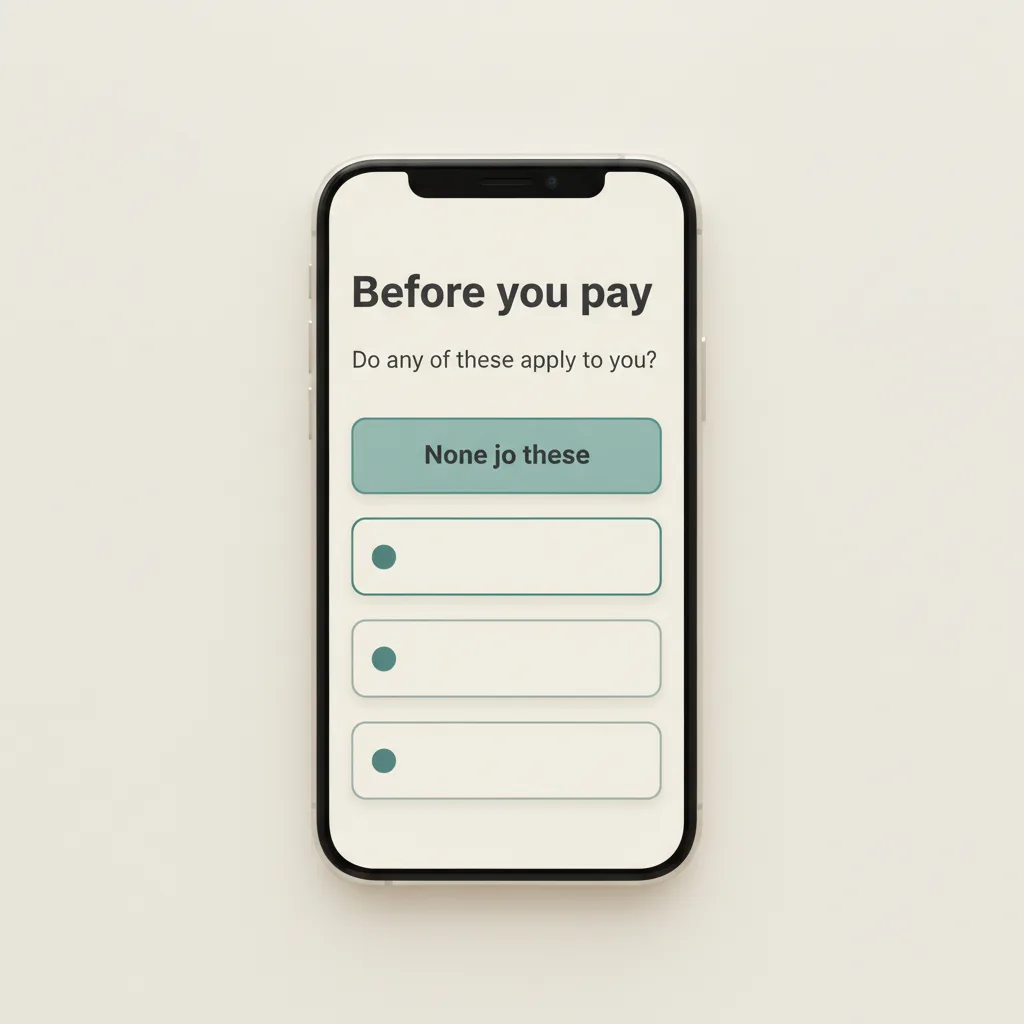
One question comes before the payment form, not after it
There is a short list of answers that make this the wrong programme for you, and the list is not negotiable. A broken bone in your spine at any point in your life, including one somebody found by accident on an X-ray. Any break in the last two years. A score of -3.0 or lower. Spinal stenosis. Blood pressure that is not under control. A doctor who has already told you not to lift.
So that question sits on the checkout page, above the card field, before you have paid a penny. Land on that list and the checkout closes. What you get instead is a page explaining exactly why, the two-page briefing written for your doctor, and real help finding a physical therapist who works with bone. All of it free, because you were never a customer.
That is deliberate and it costs me sales. A spine with a history of breaks needs somebody with a licence and their hands on it. That is not an app. And taking your money first so I can hand it back twenty minutes later would be a worse version of the same answer.
The other seven only shape the programme, they never refuse it, and they are the quick ones. Your score if you know it. Medication. A few health flags. Whether you can get up off the floor without holding onto furniture.
Most women get the standard programme. Some get a longer version: six weeks of Phase 1 instead of four, twelve sessions instead of eight, and if you reported a balance problem, the jumping work stays off for good. That is not a lesser version. More practice before more weight is the right call for some people, and the programme makes that call rather than leaving it to you on a Tuesday night.
There are also three movements that are not in this programme at any point and never will be, with a page explaining exactly why. Bending forward under load in particular has been linked to broken bones in the spine in women with thin bones since Sinaki and Mikkelsen published on it in 1984, and it is still in half the exercise videos aimed at your age group.
What twelve weeks will and will not do
I would rather lose the sale here than have you disappointed in March.
What you should expect. You will get measurably stronger, and quickly. Most women add somewhere around ten pounds to the hip hinge across the first block, and a good deal more across the second.
You will notice it outside the gym before you notice it inside one. Standing up from a low chair without pushing off the arms. The stairs at the station, with the bag, not stopping at the top. A suitcase into the overhead locker on your own. Women mention that last one constantly and it is not a coincidence, it is a hip hinge.
What you should not expect. A different number on a scan in twelve weeks.
I want to be precise, because this is where most programmes go quiet.
Bone rebuilds over months, not weeks. The trial this is built on ran eight months of twice-weekly training before it measured anything. And the scanner itself is not exact: scan the same person twice on the same machine on the same afternoon and the two numbers come out different, and that wobble is often bigger than a year of real change.
So a scan inside twelve months usually cannot tell you anything, and booking one early is a good way to feel terrible about a programme that is working.
There is a piece of writing inside called The Rescan Primer that goes through all of it properly. How big a change has to be before the machine can even see it. Why using the same clinic and the same machine matters more than anything you do in the gym. What a flat result actually means, when the alternative was carrying on losing.
It is the most important thing in the product and the least exciting, and I put it in because otherwise a woman does everything right for a year and then reads her own report wrong.
This is the wrong purchase for you if
You want something gentle. This is not chair yoga and it is not resistance bands. It starts absurdly light and it does not stay there, because staying there is the entire problem we are solving.
You want a nutrition plan. There is not one. Calcium and vitamin D are your doctor's department. Padding this out with a meal plan would make it look bigger and work exactly as well.
You want a different number on a scan by spring. Bone does not move that fast. Not yours, not mine, not anybody's, and a programme that tells you otherwise is counting on you not checking.
You will not do it twice a week. Once a week does not cross the line, which makes it a different programme rather than a smaller dose of this one. If the next three months genuinely have no room in them, wait for three that do.
You want somebody watching you lift. Then hire somebody. That is the $197 version, it is worth the money, and this is not it. This is the version for the woman who is going to do it in her own garage on a Wednesday night.
You are on the list above. The question on the checkout page will close it before you pay, so save yourself the click.
The research this is built on
From people doing it
5.0from 6 reviews
These are individual experiences and they are not typical results. Nobody here is promised a change in bone density, and how much strength somebody gains varies widely.
I teach spin four times a week and my own scan came back thin, which is the exact irony this page is built around. Reading the swimmer numbers made me stop taking it personally. I am hinging 80 lb now and my quads have never looked like this in my life.
Karen W.57, spin instructor
Twenty years of four miles a day and a score that says none of it counted for my hips. I bought the dumbbells the week I signed up and did the rucksack version for the four days before they arrived, exactly like the app suggested.
Teresa B.61, walker for 20 years
I have taught yoga for twelve years and reading the section on loaded forward bends made me go back through my own class plans with a different eye. I've changed two poses I teach because of this page, which was not the outcome I expected from a fitness purchase.
Nadia F.55, yoga teacher
My rheumatologist asked what on earth I was doing when my grip strength came back up at my last visit. I showed her the doctor briefing on my phone and she asked to have it emailed to her for another patient.
Colleen H.64, on alendronate
I already belonged to a gym and had no idea what to do with the barbell in the corner beyond feeling intimidated by it. The gym path in this told me exactly what to load and when, which is the part no membership ever included.
Beth O.59, gym member
I got the checkout question wrong the first time, an old fracture I mentioned almost as an afterthought, and it closed the checkout before I could pay. Six months later, cleared by my physio, I went back through properly and started for real. Frustrating that day, glad of it now.
Iris G.66, screened out then back in
What it costs
sixteen dollars and ninety-nine cents. One payment. Here is what the alternatives cost, because that is the only way that number means anything.
One session with a physical therapist runs somewhere between $150 and $250, depending on where you live. To learn four movements properly and get through a first block you would want ten or twelve of them. That is well past two thousand dollars, and only if you can find a therapist who has genuinely worked with thin bones, which in most towns takes a while.
The scan that started all of this cost you somewhere between $150 and $300.
Run with a practitioner, this protocol costs one hundred and ninety-seven dollars. That is what thousands of women have paid for it, one to one and in small groups, and it is a fair price for what it is.
Almost all of that number is somebody's hours. Her time taking your history. Her time watching your first hinge and telling you your back is fine, it only feels wrong because it is new. Her time answering the question you had on a Tuesday.
The app is sixteen dollars and ninety-nine cents. Same twelve weeks, same rules for adding weight, same screening, same movements in the same order. What it does not have is her standing next to you.
That is the whole difference, and it cuts both ways. If what you need is a person watching you lift, pay the one hundred and ninety-seven dollars and get one. Some women need that, and if you are one of them this is the wrong page. What I found, over a lot of years, is that most of what she was doing in those hours was the same handful of decisions, made the same way, on a schedule. That part is now in the app, and the app does not charge by the hour.
No subscription. Nothing that renews. No supplement, no equipment I take a cut of, no next level you have to buy for the programme to work. Twelve weeks, twenty-four sessions, three equipment paths, every resource, and the app.
Why it is $16.99 and not $197
This protocol is not new. It has been run with thousands of women, one to one and in small groups, and in that form it costs $197. Almost all of that is a practitioner's hours: her time taking your history, her time watching you hinge, her time answering the question you had on a Tuesday.
What is new is the app. The same twelve weeks, the same progression rules, the same screening, rebuilt so it runs without somebody standing next to you. That removes the hours and nothing else, which is why it is $16.99 instead of $197.
$180.01 of the difference is a person's time, not a discount on the programme. If what you actually need is somebody watching you lift, pay the $197 somewhere and get that. It is worth it and I will say so.
The Threshold Protocol
$67$16.99onceSave $50.01 (74%)
$16.99 is the September price. It returns to $67 on the first.
Twelve weeks. Twenty-four sessions. Three phases.
- Twenty-four sessions, written one at a timeNot a template you fill in. Two a week for twelve weeks, each one written out, with the reason for every change in it.
- All three equipment paths, in fullDumbbells at home, a barbell at home, or a gym. Own nothing yet? That is the usual answer, and the app gives you the shopping list and something to lift while it arrives. Change your path whenever your situation does.
- The app that explains itselfEvery set arrives with a suggested weight and a plain sentence saying why it chose that number. Logging a set is one tap when the prefill is right.
- The screening and the safety routingOne question before you pay, seven that only shape the program, and a program that changes shape according to the answers. The part that took longest to build and the part nobody else puts on a sales page.
- The Doctor BriefingTwo printable pages written for your clinician rather than for you, with the citations on them and a space for her to sign.
- Never Do These, and the Rescan PrimerThe three movements that stay banned for the whole twelve weeks and why, and how to read your next scan without misreading it in either direction.
Save $50.01 (74%). Goes back up to $67 on the first.
One payment. Nothing renews. Twelve weeks of program, yours to keep.
$16.99 in context
- One session with a physio who knows bone: $150 to $250, and you would want a dozen
- The DEXA scan that gave you the bad news: $150 to $300
- A year of a gym membership you are nervous about walking into: $400 or so
- Another year of walking and hoping: free, and you have been doing that
The guarantee
The guarantee is about Phase 1, on purpose
Most guarantees run thirty days, which is a number chosen because it is shorter than the time it takes to find out whether something worked.
Mine is tied to finishing the first block, because that is the point where you will actually know.
Do Phase 1. Eight sessions over four weeks. If you don't feel measurably stronger at the end of it, tell me and I'll refund every cent, and you keep everything including the Form Vault.
You keep it. I am not going to claw back a PDF from a woman who gave me four weeks and did not get what I said she would.
Before you decide
Questions
Everything people ask me before they start. If yours is not here, ask it before you buy rather than after.
I have never lifted a weight in my life. Is this for me?
Yes. I would rather have you than someone who has been lifting badly for ten years and has to be talked out of it first.
The first four weeks contain almost no weight. Eight sessions, four movements, and the loads are light enough that most women spend the first two or three sessions on an empty barbell or a pair of twenty pound dumbbells. That is not me being delicate with you. It is that the technique has to become automatic before the load gets interesting, and the only way technique becomes automatic is dull repetition. Phase 1 is repetitive on purpose. I say so inside the sessions too, because when people see the same four movements over and over they assume they bought a thin program.
What you actually learn in those four weeks is short to list. How to hinge at the hip without your back rounding. How to squat to the depth your hips have today instead of the one you had at thirty. How to press something overhead without your ribs flaring open. How to row.
Nobody is watching you, which is the good news and also the problem. So the last session of Phase 1 is a self check: you film your four movements for your own eyes, judge each one against a short checklist, and record your four answers in the app. The films stay on your phone and nobody else ever sees them. Phase 2 stays shut until all four answers are recorded. That gate is not a motivational trick. It is the substitute for a coach standing beside you.
The trial this program is built on recruited postmenopausal women who were not already lifting weights, and had them lifting heavy inside a couple of months (Watson, Weeks, Weis, Harding, Horan and Beck, 2018). Every one of them had a supervisor within arm's reach for every set. You have a phone and a checklist. That is why my ramp is slower than theirs was.
Am I too old for this?
I have not found the ceiling yet. The women in the LIFTMOR trial averaged around sixty five years of age and still gained bone density in the lower back and at the top of the thigh bone over eight months (Watson et al., 2018).
If you are somewhere between fifty and seventy and you can get up off the floor without pushing on a chair, your age is not the limiting factor. Your loading history is. Those are two different problems and this program is aimed at the second one.
The floor question is question eight in the screening. It is not decoration. Answer it honestly and the program adjusts.
I already have osteoporosis. Is lifting heavy actually safe for me?
Sometimes yes and sometimes no, which is why there is a screening system rather than a guess made from a sales page.
Start with the evidence. The LIFTMOR trial did not only include women with osteopenia. It included women who already had osteoporosis, and they lifted at high intensity twice a week for eight months (Watson et al., 2018). A second look at that trial found the training broke no bones in the spine, and the forward curve of the upper back got better rather than worse. That is a genuinely surprising result and it is the reason this program exists at all.
Now the part the trial does not give me. Every one of those women was supervised, in a university setting, by people who had screened them first and who could stop a set mid rep. I am not in the room. So I have to do the screening in advance and be stricter than they were, because strictness is the only tool I have left.
This is the list that makes the answer no, and you meet it before you pay: it is the question above the card field on the checkout page.
- A T-score of -3.0 or below.
- A broken bone in your spine, ever, even if your T-score looks fine.
- Any fracture at all in the last two years.
- Spinal stenosis or spondylolisthesis.
- A T-score between -2.5 and -2.9 together with a curve in your spine, forwards or sideways.
Any of those and the checkout does not open. You get a page explaining why in plain language, the Doctor Briefing to take to a specialist, and a free guide to finding a physical therapist who works with bone, all of it free because nothing was charged. Your answers are saved with your order, so the app never asks them again. If an answer was wrong, or something changes, redo the screening inside the app: an answer on that list locks the training and the page tells you where to write. One line is enough, you never have to explain yourself, and a refund on that ground is not one anybody here argues with.
A T-score between -2.5 and -2.9 on its own does not lock you out. It puts you on the extended ramp, which turns Phase 1 into six weeks and twelve sessions instead of four and eight, and holds the impact work back until the second week of Phase 2.
One more thing that matters more than the T-score. The movements that break thin spines are bending forward and twisting with weight in your hands, not standing up with it. That is why loaded forward bending, loaded twisting and the standing toe touch are permanently banned here, why they exist in the app as records you can look at with the word never next to them, and why a link to that page sits at the bottom of every single session.
I already walk, swim, cycle and do yoga. Is that not enough?
This is the question I care most about, so I am going to take longer over it than the others. Please read the whole thing.
Consider Olympic swimmers first. Female Olympic swimmers have been measured with bone density in their legs no better than women the same age who do no sport at all (Bellver et al.). One study put swimmers 9.8% lower in the bones of the legs than people who did no exercise, with the endurance specialists 14.8% lower. Twenty hours a week in the water. Some of the fittest women on the planet. Worse legs than a woman who sits at a desk.
The cyclists tell the same story and they tell it louder. Two thirds of one professional road cycling team had bone density well below the normal range (Medelli et al.). Ten of nineteen elite Norwegian endurance cyclists had low bone density, and one of them had frank osteoporosis (Andersen et al.). Road cyclists show osteopenia at around 63% against 19% in runners, and the usual explanation is that cyclists carry roughly half the loading history.
So why. Not fitness, clearly. Not effort, obviously not. Here is the reason.
Bone is rebuilt continuously in response to mechanical load, and it only adds material when the strain going through it crosses a threshold. Below that threshold it quietly sheds material it has no evidence it needs. Harold Frost described this in 1987 and it is still the model everyone works from. Your skeleton is not broken. It is thrifty. It will not pay to maintain structure that nothing is asking for.
Which means the last thirty years of your exercise, all of it, sent almost no signal. Walking is a load your skeleton has handled since you were one year old and it stopped being news a very long time ago. Yoga holds you slowly against your own body weight, which is the same weight you carry to the kitchen. Swimming takes gravity away on purpose. Cycling is seated, smooth, and your feet never strike anything. Four disciplined activities. Four near zero osteogenic signals.
And then menopause arrived and the number on your scan was bad, and you concluded that menopause did it. It did not. Menopause removed the buffer that had been hiding thirty years of it.
So the answer is not more exercise. It is a different signal.
Read that line again, because it is the whole product. More walking will not fix this. Longer swims will not fix this. Adding a fourth yoga class will not fix this. The thing that is missing is not volume, it is intensity of load, and no amount of the first substitutes for the second.
Australian researchers tested precisely this on women who already had bone loss. The LIFTMOR trial had postmenopausal women with osteopenia and osteoporosis lift heavy and do some jumping work, five sets of five reps at more than 85% of the heaviest they could lift once, twice a week, thirty minutes a session, supervised, for eight months. It measured real gains in bone density in the lower back and at the top of the thigh bone, where it goes into the hip (Watson, Weeks, Weis, Harding, Horan and Beck; Journal of Bone and Mineral Research, 2018).
What you are buying is that protocol, rebuilt to run without a supervisor standing next to you. That rebuild is not cosmetic. It is a four week technique ramp before any real load, effort based targets instead of percentages of a maximum you have never tested, form gates that hold the next phase shut, and a screening system that will refuse to sell some women this program. The trial was supervised. We are not. Everything unusual about how this program is shaped comes out of that one sentence.
Where I will hedge, since I would rather you hear it from me. I do not know how much of the swimmer and cyclist finding is the missing load and how much is low body weight and poor energy availability in elite sport. My honest read is that it is both, with load doing most of the work. The threshold logic holds either way, and it holds for you regardless, because you are not an elite athlete and you are not underfed. You are a woman who was told to do cardio and be careful with her back, and who did exactly that.
Keep the walking. Keep the yoga. I am not asking you to give up one thing you enjoy. Walking is good for your heart, your head, your sleep and your hips staying mobile. It is simply not good for your bone density, and it never was, and nobody told you.
You did not fail at this. You were given the wrong instructions and you followed them faithfully, which is somehow worse, because the discipline was real the whole time.
I am on alendronate. Does exercise still matter if I am medicated?
The drug and the load are doing two different jobs, and only one of them is being done right now.
Bisphosphonates such as alendronate work mainly by slowing down the cells that remove bone, so what you have is held on to for longer. That is a real and useful thing. It is also a defensive thing. Mechanical load is the signal that tells the body to add material in the first place, and nothing in a tablet supplies that signal (Frost, 1987). Slowing the loss and prompting the gain are not the same job, and one does not stand in for the other.
Your medication status does not change anything about your program. In the screening there is a question about it, and the answer never affects your tier. It is captured so the app can talk to you correctly in a few places, and for nothing else. A woman on alendronate with a T-score of -2.0 and a woman on nothing with a T-score of -2.0 get the identical twelve weeks.
Two things I will not pretend to know. I have never seen a trial that took women already on a bisphosphonate, randomised half of them into a LIFTMOR style program, and measured what the combination does over a year. Somebody should run it. And I cannot tell you the effects simply add up, because that is not how biology usually behaves.
My read is that the drug protects the floor and the load raises the ceiling, and that you want both. That is a judgement, not a finding.
Tell your prescriber you are starting to lift weights, getting heavier over time. Take the Doctor Briefing with you. If they restrict your loading, that is on the question above the card field on the checkout page, and answering it honestly closes the checkout before you have paid anything. There is no refund to ask for, because there is no charge.
I finished a five year course of medication and my doctor told me to stop. What now?
You are standing at the point in this whole story that bothers me most, so I will be direct.
Bisphosphonates are commonly stopped after about five years, because the added benefit flattens out while the rare side effects keep accumulating. That decision is usually correct. What nobody hands you along with it is the second half of the plan, because for most women there is no second half. The medication held a line for five years, the medication is withdrawn, and the thing that put you in the clinic in the first place has not been addressed at all.
How quickly bone turnover picks back up after stopping varies a great deal from woman to woman, and I cannot predict yours. Nobody can from where I am sitting. What I can tell you is what does not change: load is still the only input that asks bone to add material, and load has no five year limit and no holiday.
So the five year mark is either the moment your care stops, or the moment it changes shape. That is genuinely up to you now, and it is a bit unfair that it is.
There is a question in the screening about medication status with an option for having finished a course. Tick it. The app will speak to you slightly differently in a few places because of it, and the Rescan Primer will frame your next scan differently too. It changes nothing about your training. It changes what I say to you.
One caution. Coming off a drug is not a reason to train harder or faster than the plan says. If anything it is a reason to be rigid about the ramp, because the four weeks of Phase 1 cost you almost nothing and buy you a spine that knows what it is doing before the weight gets real.
I have no gym and no equipment at all. Can I still do this?
Yes, and owning nothing is the most common starting point rather than the awkward one.
Start with what is in the house. The first four weeks are eight sessions of learning four shapes at a weight you could carry up a flight of stairs, and a rucksack loaded with books or bottled water does that job honestly. Weigh it on your bathroom scale, put the number in the app, and the progression works exactly as it does for everyone else.
Order one pair of adjustable dumbbells while you do that. Roughly a hundred and fifty to three hundred dollars for the pair, they fit under a bed, and they are the whole shopping list. Secondhand is completely fine. Cast iron does not wear out.
What I will not tell you is that you can do this forever with nothing. Your own body weight is the load your skeleton adapted to decades ago, which is the entire argument this program is built on. Anybody selling you a bodyweight routine for your bones is selling you the problem. The rucksack gets you started, not finished.
Once you have the weights: the dumbbell path is written out in full, all twenty four sessions, all nine movements, with its own starting loads and its own increments. It is not a stripped down version of the barbell program with a note apologising for itself. You pick your path at signup and you can switch later without losing your history.
Some of it is genuinely better with dumbbells. The overhead press lets each shoulder find its own groove instead of being locked to a bar. The row is easier to keep square. The split squat and the suitcase carry are dumbbell movements anyway, on every path.
Now the honest bit, because this is where most programs go quiet.
Around week eight, on the hinge, your hips are going to out-pull your grip. Two heavy dumbbells become a hand problem long before they become a hip problem, and when that happens your bone stops getting the signal that your legs are perfectly capable of delivering. It is the single real limitation of the path and it arrives on a fairly predictable schedule.
When you hit it, you have options in roughly this order of cost:
- Lifting straps. About fifteen dollars. Fixes the grip issue on the hinge immediately and buys you months.
- Move the hinge to one dumbbell held vertically between your legs, so all the load sits in two hands on one handle rather than split across two.
- Adjustable dumbbells that go to fifty or sixty pounds per hand.
- A barbell and a few plates, which is the honest end point if you intend to keep training past this year.
I do not sell any of that. There is no affiliate link anywhere on this site and there never will be. Which is precisely why you can believe me when I say the dumbbells are genuinely enough for the first block and genuinely limiting by the second.
Do not wait until you have the perfect setup. Start with what is in the house.
How much time does this take?
Two sessions a week, around thirty five to forty minutes each. The shortest in Phase 1 is under thirty and the longest in Phase 2 runs closer to fifty, and most of the difference is you standing still between heavy sets. That rest is not padding and I will not let you shorten it.
Will this hurt my back?
Somebody told you that bending over is how you hurt your back. Bending over with a rounded spine under load is how you hurt your back. Those are two different sentences and the difference is the entire hinge chapter.
The movements that damage a fragile spine are bending forward and twisting with weight in your hands. So three things are banned here permanently, on every path, for every member, at every tier: loaded forward bending, loaded twisting and the standing toe touch. They live in the app as their own records so you can look at each one and read why. A link to that page sits in the footer of every session you will ever open.
The one rule I will not bend on:
- If something goes sharp, you put the weight down mid set. Not at the end of the set. Mid set. There is not a single rep in these twelve weeks worth finishing.
There is also a stop conditions banner at the top of every session page. It collapses after you have acknowledged it once, because I trust you to have read it, but it never goes away entirely.
On the evidence. The companion analysis of LIFTMOR found that the heavy training broke no bones in the spine, and that the forward curve of the upper back got better over the eight months (Watson et al., 2018). That result is most of why this program exists. Those women were supervised and you will not be, which is why your first four weeks go almost entirely on making sure your back does not round rather than on making anything heavy.
Some of you should not start at all, and you find that out before you pay. A broken bone in your spine at any point in your life, spinal stenosis, spondylolisthesis, or any break in the last two years, and the checkout closes rather than opens.
What your back will actually feel like. Everybody who trains gets sore. Sore across both hamstrings and your backside two days after a hinge session is ordinary and it mostly stops happening by week three. A dull ache low down that is gone by the next morning is fine. A sharp line in one spot, a pinch, a sting, or anything electrical running down one leg is not soreness. That is a stop, and then a message to a physio, not a message to me.
I have arthritis in my knees and my hands. Does that rule me out?
No, and you will notice arthritis is not one of the eight screening questions. That is deliberate. It is too common and too variable to route on. If a doctor has restricted your loading because of it, that is question seven and it is handled there.
Knees first. You set the depth, not me. Nowhere in this program does it say how far down you have to go, and there is no depth standard to fail. Squat to a box or a chair set at a height your knees are content with, and let that height come down over the weeks if it wants to. It usually does. If the split squat is the movement that hurts, swap it for the hip thrust, which loads the same hip and asks nothing of the knee joint.
Loading an arthritic joint through a range it tolerates is generally well handled and often reduces pain over a matter of weeks, whereas avoiding load tends to make the joint worse over time. My working rule is simple. Pain above about three out of ten during a set means stop the set. Joint pain that is still worse twenty four hours later means the last session was too much and you go back a step.
Hands are the more common limiter, honestly. Grip fails before hips do for most women over sixty, and arthritic hands fail sooner. Straps solve it for about fifteen dollars and I would rather you use them from week one than lose the hinge entirely. The suitcase carry is the one place I do not want you to strap up, because grip is the point of that movement, so shorten the carry instead and keep the load in your fingers.
If your hands are bad on a given day, train the day anyway and drop the hinge load by ten percent. A lighter session logged beats a perfect session skipped, and the app will not scold you for the number.
What if my doctor tells me not to do this?
Then you do not do it, and I refund you.
That is the question above the card field on the checkout page. Answer it yes and the checkout closes before you have paid anything. You get a page that explains the position respectfully, the Doctor Briefing to take back with you, and help finding a physio who actually specialises in bone. All of it free, because you were never charged. If your doctor clears you later, everything is still here at the same price. I am one step removed from you and your doctor is not.
Before you ask them, though, take the Doctor Briefing with you. It is two printable pages, it is free and public on this site, and you do not need to buy anything to read it.
Here is why that matters. Most of the no answers I hear about are answers to a question that sounded like "should I lift weights with osteoporosis," which lands in a busy ten minute appointment as a question about maximum deadlifts in a commercial gym. The briefing states what the protocol actually is, which trial it comes from, what the loads and rep ranges are, and which conditions rule a woman out. Given that, some answers change.
Some do not. Sometimes the no is a real no, based on something in your file that I cannot see from here. I am not going to teach you how to argue with your doctor and I would think less of a program that did.
How fast will I see anything?
Strength moves in weeks. Bone moves in scans. Those two sentences are the honest summary of the whole timeline and I would rather lead with them than with a promise.
The strength part is quick and it is measurable. Most women add about ten pounds to the hinge across the first block, then move faster than that in Phase 2 once the technique stops costing them attention. The app shows you the total weight you moved today against your first session of the same type, in pounds, on the screen at the end. Seeing 2,340 next to 1,150 does something that a paragraph of encouragement cannot.
The moment women actually write to me about tends to land somewhere between session six and session nine, and it is almost never the number on the bar. It is carrying the shopping in one trip. Getting off the floor without planning the route first. Standing up from a low sofa without the arm.
Bone is slower and there is no dashboard for it. Nothing you feel in week five is bone. That is what the next question is about, and I would read it before you buy rather than after.
Will my next DEXA scan show improvement?
I do not know, and anybody who tells you they do is selling you something worse than this.
What I can give you is a realistic frame. The Rescan Primer that comes with the program does exactly that.
Twelve weeks will not show up on a scan. Do not book one for week thirteen. You will pay a hundred and fifty to three hundred dollars to be told nothing, and then you will conclude the training failed when what actually happened is that you measured too early. LIFTMOR ran for eight months before it measured change, and even that is a short study by bone standards (Watson et al., 2018).
Then there is the machine itself. A DEXA scanner is not exact, and in the lower back a change smaller than about three percent often cannot be told apart from the machine's own wobble. Use the same clinic and the same machine as last time if you possibly can. A different machine can hand you a different number for a spine that did not change at all.
And the result that most women do not count and should. Untreated bone loss after menopause typically runs somewhere around one to two percent a year. A number that is flat across two years is not nothing happening. It is several percent that did not leave.
What I cannot promise you is your particular scan. The trial reported group averages, and inside any group average there are individuals who did much better and individuals who did nothing at all. I have no way to tell you in advance which one you will be, and the honest version of this product says that out loud on the sales page rather than in a footnote afterwards.
There is a page in the app about what to do if the number does not move. It was written before you bought, not after you were disappointed. The app also asks for your rescan date and starts a specific eight week preparation sequence sixty days before it, because turning up to that appointment having trained for a year and having no idea what to ask for is a waste of the year.
Do I need a spotter or a training partner?
No, and the program is deliberately shaped so that you never do. Nothing in the twelve weeks puts a loaded bar over your throat or behind your neck. The press goes overhead from the front where you can step out from under it, the hinge you simply set back down, and if you are squatting in a rack you set the safety pins at the bottom of your depth so the worst possible outcome is that you sit down and the bar lands on steel.
A partner does help with turning up on a wet Tuesday. That is adherence, not safety, and they are different problems.
For technique, your phone beats a partner anyway. A partner watches once from a bad angle and says it looked fine. The video does not.
Is there a subscription? Is there a supplement I have to buy?
No and no. No monthly charge, no auto renewal, nothing to swallow, and no equipment I earn a cent on. Every purchase here is one payment for something you keep.
What exactly do I get for the money?
sixteen dollars and ninety-nine cents, once, for the following.
- Twenty four sessions across twelve weeks, written out one at a time. Two a week. Not a template you fill in yourself.
- All three equipment paths written in full: gym barbell, home barbell, and dumbbell only. You pick one at signup and you can change it later.
- The screening, the safety routing and the phase gates, which are the parts that took the longest to build and which nobody puts on a sales page.
- The app. Every set gets a suggested weight and a plain sentence explaining why it picked that number. Logging a set is one tap if the prefill is right. Strength charts per movement on the home screen. A twenty four cell grid that fills in as you go, with no confetti and no badges on it.
- The Doctor Briefing, two printable pages with the citations on them, written to be handed across a desk rather than read by you.
- Never Do These, which is the three banned movements and why.
- The Rescan Primer and Reading Your Own Progress, which between them are the two documents that stop you misreading your own results in either direction.
At checkout there is one unchecked box for the Form Vault at fourteen dollars and forty-nine cents. That is a deeper reference card for each of the nine movements: setup, the cues in order, three common faults each with a correct and incorrect picture, a self filming protocol telling you exactly where to put the phone for each lift, and a troubleshooting index that goes from what you feel to what is probably causing it. It is genuinely optional. The form guidance you need to train safely is already in the program.
For scale. One session with a physio who knows bone runs a hundred and fifty to two hundred and fifty dollars, and you would need a dozen of them to cover this ground. The scan that gave you the bad news in the first place cost you somewhere between a hundred and fifty and three hundred.
What is the guarantee, and how does the refund work?
Do Phase 1. Eight sessions over four weeks. If you don't feel measurably stronger at the end of it, tell me and I'll refund every cent, and you keep everything including the Form Vault.
I tied it to finishing Phase 1 on purpose. A thirty day no questions refund rewards the woman who buys, does nothing, and asks for her money back on day twenty nine. That woman is not the problem, she is just the outcome of a badly built promise. Eight sessions is four weeks of your life and it is the smallest amount of work that makes the question answerable.
If the screening put you on the extended ramp, your Phase 1 is twelve sessions over six weeks, and the same promise covers it with the same generosity.
If the screening routes you to red, I am not selling you a barbell, and it happens before your card is touched. The questions are on the checkout page above the card field, so a woman it refuses is refused while her money is still hers. If it was your spine, you are pointed at The Upright Protocol, which is written for exactly those answers. If it closed training altogether, there is nothing here you can safely do, and you were never charged for finding that out.
Some women bought before those questions moved to the checkout, and were closed inside their accounts instead. Nothing about their promise has changed. The Upright Protocol goes on the account at no charge, the two cost the same, and if you would rather have the money it comes back in full. I will ask one thing, what went wrong, in case it is something I can fix, and your answer never changes the money. I would rather refuse a sale than take money from a woman who should be seeing a specialist.
What this is not is a thirty day trial. If you get part way in and something is genuinely in the way, tell me what it is. Half the time it is a swap or a weight, and I would rather fix that than take your money for nothing. If I cannot fix it, the money comes back. If you simply have not started, the promise above is the one I am making, and it is waiting for you at session eight.
What happens after twelve weeks?
Session twenty four is an assessment. You record your numbers on the hinge, the squat, the press and the row, and those become the baseline everything afterwards is compared against. That session exists whether you ever buy another thing from me or not.
Then you have three real options and I will describe all of them fairly.
Repeat the twelve weeks with your new starting loads. It costs nothing, the sessions stay in your account with no expiry, and it works, because adding weight over time works whether or not the sessions are new. It is the least interesting option and it is not the wrong one.
Or take The Next 12 Weeks at seventeen dollars. That is block two, weeks thirteen to twenty four, the load block, in the same app with the same rules. It comes with Rescan Ready, the Deload Doctrine, and a quarterly self assessment that compares your four benchmarks against your own history rather than against a table of other women.
Or take The Full Year, which is offered once on the page right after you buy, and later inside the app at the difference. It is weeks thirteen to fifty two.
Read that offer carefully, because it is buying ahead of writing and it says so on its face. Weeks thirteen to twenty four are in the app today. Weeks twenty five to fifty two are not written yet. They arrive one block at a time, ahead of you, as you reach them, against a date I work to. If I am late you get the difference back without asking, and you keep everything that has landed.
If buying ahead of writing is not for you, take The Next 12 Weeks or repeat what you have. Both are real answers and neither costs you anything you have already paid for.
Now the part that matters more than any of that. Bone responds to loading over months and years rather than weeks, and even the LIFTMOR trial ran for eight months before it measured anything (Watson et al., 2018). Twelve weeks makes you strong enough and skilled enough to train properly. It is the ramp, not the destination, and that is worth knowing while you are deciding rather than in March.
Whatever you choose, keep loading something. That is the only instruction that never changes.
Is there an app to download, and how do I get back in?
There is nothing to download, and that trips people up, so here it is plainly. Your programme is a website. It lives at latticehealth.online/app and it opens in the browser you already use, on any phone or computer.
To get back in, go to that address and put in the email you bought with. A sign-in link comes to your inbox. No password, ever.
To make it feel like an app, you can add it to your home screen. The steps are on your Account page, under "Getting back in quickly". On an iPhone it starts with the share button, the square with an arrow coming out of the top, at the bottom of the screen. After that it opens with one tap like everything else on your phone.
If the sign-in email does not arrive in a few minutes, check spam first. Then check the receipt from your purchase and use the exact address it was sent to. The account always lives on the address you bought with.
I paid but I cannot see my programme. Where is it?
Your programme is attached to the exact email address you paid with. Nine times out of ten, this is the whole problem: you are signing in with a different address than the one on your receipt.
Open the receipt from your purchase and read which address it went to. Then sign in at latticehealth.online/app with that address, letter for letter.
If that is already what you did and it still says no account, tell the chat the address on your receipt and whether you paid by card or through PayPal. It checks the payment itself and repairs the account on the spot, and it keeps re-checking on its own afterwards. You do not need to send screenshots or prove anything.
Nothing you paid for goes anywhere while this gets sorted. The purchase is on record with the card company or PayPal either way.
I have carpal tunnel or a wrist problem. How can I lift anything?
Honestly: it depends which movement, and the answer is different for each one. So here is what the program actually asks of a wrist, movement by movement, and you can take it to whoever knows your wrists.
There are four main lifts. The hinge and the row both ask you to hold a heavy thing in your hands. That is a grip problem, and grip problems have a cheap fix: lifting straps, about fifteen dollars, which take the weight off your fingers and put it on the strap. I would rather you use them from week one than lose the hinge. The suitcase carry is the one place straps defeat the purpose, because grip is the whole point of it, so that one gets shortened instead.
The squat is easier than it sounds. On the dumbbell path you hold one weight against your chest with your elbows underneath it, so your wrists are stacked and not bent. On the barbell path the bar rests on your upper back and your hands are only steadying it.
The overhead press is the one to ask about. Pressing overhead loads the wrist and the forearm directly, and the setup asks for wrists stacked over the elbows rather than bent back. Straps do not help with that, because the load is going through the joint rather than the fingers. There is no swap written for it and I am not going to invent one for you here.
Two things worth knowing before you decide. The press is the lift I am least confident changes bone at the hip or the spine, and I say so on its own page: my read is that it earns its place through the upper body and posture rather than through the scan sites. So it is not the heart of the program. And a nerve or a tendon under pressure is not the same kind of problem as a stiff joint, which is why this is a question for a doctor or a hand therapist rather than for me.
Take the Doctor Briefing with you. It is free, it is on the site, and it lays out exactly what the twelve weeks load and how heavy it gets, which is the thing a clinician needs in order to give you a real answer instead of a cautious one.
If the answer comes back no, tell us within the guarantee window and you get your money back. You are not stuck with it while you find out.
When a session says 20 lb, is that per dumbbell or the total?
Per hand, when the movement uses two dumbbells. If a session says 20 lb on the overhead press, the hip hinge, the row or the split squat, that is a 20 lb dumbbell in each hand, so 40 lb in total. Your session screen now says "per hand" next to the number on those movements, so you never have to guess.
When the movement uses one dumbbell, the number is the whole of it. The goblet squat is one dumbbell held at your chest. The suitcase carry and the suitcase hold are one dumbbell in one hand. The hip thrust is one dumbbell across your hips. On those, 20 lb means one 20 lb dumbbell.
On a barbell, the number is the bar and the plates together.
Log what was in your hands, the same way. Put the per-hand number in on a two-dumbbell movement, and the app works out your next weight from that. If you logged the total by mistake, open the session from your history, tap Change on the set, and put the per-hand number in. Nothing else needs fixing.
Can I buy now and start later?
Yes. Nothing you buy expires. The programme sits in your account until you open it, and a session you have not started does not count down. Buying in September and starting in November is fine, and the price you paid is the price you paid.
Two things are worth knowing before you go quiet for a while.
The rest gap between sessions runs from your last logged set, not from the day you bought. So if you stop for three weeks, the next session is waiting when you come back, and nothing sends you backwards. You pick up at the session that was next.
The guarantee is linked to finishing Phase 1 and it has a time limit from the day you buy, which is printed on the refund page. If your plan is to buy now and start months later, that limit can run out before you have done eight sessions. If that is you, say so in one line to support when you buy, on the same email thread, so the date you told us about is on record. That thread is what the guarantee is read from if you ever need it.
Two versions of the next twelve weeks
You are going to spend the next twelve weeks somehow. That is the part worth sitting with, because there is no version of this where nothing happens.
Here is the first one.
You close this page. Nothing bad happens tomorrow, and that is exactly the trap. There is no pain to react to and no deadline, so it never quite becomes the week you start.
You keep walking. You keep swimming. And your skeleton keeps getting the same message it has had for thirty years, which is that everything is fine and it can carry on downsizing.
Next spring there is another scan, and the number has moved the wrong way again. Not dramatically. Just enough.
And the careful gets a bit wider each year. The rail on the stairs, then the rail in the shower. You stop carrying the shopping in one trip. You let somebody else get the boxes down. You say no to the trip with the walking on it, and you tell everyone you did not fancy it.
Then one ordinary Tuesday there is a kerb, or a wet floor in a supermarket, or the edge of a rug.
And it is not the fall that takes the year off you. It is what comes after. Three weeks in a hospital bed. Somebody else washing you. Your daughter on her phone at the end of the bed, looking up stair lifts and quietly saying the word "bungalow".
I am not saying that to frighten you and I am not saying it is certain. I am saying it because it is the thing you already lie awake about, and pretending we are both here for something else would be insulting.
Here is the second one.
You start on Tuesday, with a weight so light it feels silly. That is on purpose. It is going to feel silly for about three weeks.
By week five the bar has something on it that you would not have believed in January. By week eight you stand up from the low sofa without thinking, and you notice about an hour later that you did not push off the arms.
Somewhere around week ten you carry both bags of shopping in from the car in one trip, in the rain, and it is not a triumph. It is just what happened.
And then the part that actually matters, which is not a number and never was.
You stop being careful. Not reckless. You just stop running the calculation. The ice, the ladder, the grandson with his arms up. The voice in the back of your head that started keeping score the day the letter came goes quiet, because you have twelve weeks of evidence that it is wrong about you.
You are no longer a woman with a bone problem, managing it. You are a woman who deadlifts twice a week.
I cannot promise you a number on a scan, and nobody can. The ones who do are counting on you not still reading their emails in eighteen months.
What I can tell you is this. The mechanism is not in dispute. The protocol has been run on women who already had osteoporosis. And the version in front of you is that protocol, rebuilt to be safe with nobody standing next to you.
Twelve weeks. Twenty-four sessions. sixteen dollars and ninety-nine cents, once. Refunded in full if the first four weeks do not make you measurably stronger.
You have been careful long enough.
Rebuild the structure.
Save $50.01 (74%). Goes back up to $67 on the first.
One payment. Nothing renews. Twelve weeks of program, yours to keep.
P.S. If you take one thing from this page and never buy anything, take this. The reason your exercise has not protected your bones is that it never loaded them hard enough to be worth building for. That is not a criticism of you, and it is fixable at any age. Take the Doctor Briefing, which is free, and go and have the conversation.
P.P.S. About that one question on the checkout page. A meaningful number of women answer it in a way that closes the checkout before it opens. Every one of them still gets the doctor briefing and the free guide to finding a physical therapist who works with bone. Nothing paid, nothing to claim back, nothing lost but a few minutes. I would rather that happened a hundred times over than have one woman with a broken bone she never mentioned load a bar because I wanted the sale.